Is sample mean equal to population mean?

elquicko

New member
Joined
Nov 17, 2013
Messages
12
I am reading in my text book and many other sources that it is but I am also reading other sources online that say it isn't, and that the standard error of the mean is an approximation of the difference.
I understood that standard error is the standard deviation of repeated measures. Help with some clarification please.
 
If you took a sample of the data of the population, the sample mean *
would not necessarily equal the population mean. *

* arithmetic average
 
Is sample mean equal to population mean?

I am reading in my text book and many other sources that it is but I am also reading other sources online that say it isn't, and that the standard error of the mean is an approximation of the difference.
I understood that standard error is the standard deviation of repeated measures. Help with some clarification please.
Please quote exactly what you read!

It should be obvious that the mean of a particular sample will only rarely equal the mean of the population; but the mean of the distribution of sample means is equal to the population mean, so that any particular sample mean will be an approximation of the population mean. The specific words make a big difference!

Here is what Wikipedia says:

The sampling distribution of a population mean is generated by repeated sampling and recording of the means obtained. This forms a distribution of different means, and this distribution has its own mean and variance. Mathematically, the variance of the sampling distribution obtained is equal to the variance of the population divided by the sample size. This is because as the sample size increases, sample means cluster more closely around the population mean.​
... In other words, the standard error of the mean is a measure of the dispersion of sample means around the population mean.​

So the standard error of the mean isn't so much an estimate of an individual sample's mean's deviation from the population mean, as a measure of how far such sample means typically vary. On average, the sample mean is close to the population mean, but it varies; and the bigger the sample, the less you can expect it to deviate.

 
Please quote exactly what you read!

It should be obvious that the mean of a particular sample will only rarely equal the mean of the population; but the mean of the distribution of sample means is equal to the population mean, so that any particular sample mean will be an approximation of the population mean. The specific words make a big difference!

Here is what Wikipedia says:

The sampling distribution of a population mean is generated by repeated sampling and recording of the means obtained. This forms a distribution of different means, and this distribution has its own mean and variance. Mathematically, the variance of the sampling distribution obtained is equal to the variance of the population divided by the sample size. This is because as the sample size increases, sample means cluster more closely around the population mean.​
... In other words, the standard error of the mean is a measure of the dispersion of sample means around the population mean.​

So the standard error of the mean isn't so much an estimate of an individual sample's mean's deviation from the population mean, as a measure of how far such sample means typically vary. On average, the sample mean is close to the population mean, but it varies; and the bigger the sample, the less you can expect it to deviate.

Bernard Rosner Fundamentals of biostatistics:

"These values will be denoted by x1, x2, and so forth. In other words, we forget about our sample as a unique entity and consider it instead as representative of all possible samples of size n that could have been drawn from the population." (Rosner, 165)

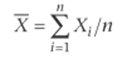
1600287978192.png

The book states that sample mean is calculated in the above way.
 
Top