
You are using an out of date browser. It may not display this or other websites correctly.
You should upgrade or use an alternative browser.
You should upgrade or use an alternative browser.
Limit comparison help
- Thread starter Moistwh
- Start date

- Joined
- Nov 24, 2012
- Messages
- 3,021
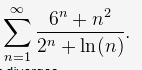
I'm thinking I would try:
[MATH]b_n=3^n[/MATH]
since:
[MATH]\frac{a_n}{b_n}=\frac{\dfrac{6^n+n^2}{2^n+\ln(n)}}{3^n}=\frac{6^n+n^2}{6^n+3^n\ln(n)}[/MATH]
So, what is:
[MATH]\lim_{n\to\infty}\left(\frac{6^n+n^2}{6^n+3^n\ln(n)}\right)[/MATH] ?
[MATH]b_n=3^n[/MATH]
since:
[MATH]\frac{a_n}{b_n}=\frac{\dfrac{6^n+n^2}{2^n+\ln(n)}}{3^n}=\frac{6^n+n^2}{6^n+3^n\ln(n)}[/MATH]
So, what is:
[MATH]\lim_{n\to\infty}\left(\frac{6^n+n^2}{6^n+3^n\ln(n)}\right)[/MATH] ?
- Joined
- Nov 24, 2012
- Messages
- 3,021
The limit is 1, meaning that the series is divergent, since 3^n is a divergent series with r > 1
Thank you
Yes, exactly!
