
I have the attached problem for which i need to solve a,b, and c.
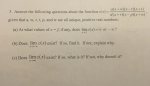
\(\displaystyle \mbox{3. Answer the following questions about the function }\, c(x):\)
. . . .\(\displaystyle c(x)\, =\, \dfrac{a\, (x\, +\, w)\, (x\, -\, r)\, (x\, +\, t)}{d\, (x\, +\, r)\, (x\, -\, p)\, (x\, +\, w)}\)
. . . .\(\displaystyle \mbox{with }\, a,\, w,\, r,\, t,\, p,\, \mbox{ unique positive real numbers}\)
\(\displaystyle \mbox{(a) At what values of }\, x\, =\, f,\, \mbox{ if any, does }\, \lim_{x\, \rightarrow\, f}\, c(x)\, =\, +\infty\, \mbox{ of }\, -\infty \mbox{ ?}\)
\(\displaystyle \mbox{(b) Does }\, \lim_{x\, \rightarrow\, -w}\, c(x)\, \mbox{ exist? If so, find it. If not, explain why.}\)
\(\displaystyle \mbox{(c) Does }\, \lim_{x\, \rightarrow\, \infty}\, c(x)\, \mbox{ exist? If so, what is it? If not, why doesn't it?}\)
I'm a bit intimidated by the amount of variables and don't really know where to begin with this problem. If someone could help walk me through this it would be greatly appreciated.
\(\displaystyle \mbox{3. Answer the following questions about the function }\, c(x):\)
. . . .\(\displaystyle c(x)\, =\, \dfrac{a\, (x\, +\, w)\, (x\, -\, r)\, (x\, +\, t)}{d\, (x\, +\, r)\, (x\, -\, p)\, (x\, +\, w)}\)
. . . .\(\displaystyle \mbox{with }\, a,\, w,\, r,\, t,\, p,\, \mbox{ unique positive real numbers}\)
\(\displaystyle \mbox{(a) At what values of }\, x\, =\, f,\, \mbox{ if any, does }\, \lim_{x\, \rightarrow\, f}\, c(x)\, =\, +\infty\, \mbox{ of }\, -\infty \mbox{ ?}\)
\(\displaystyle \mbox{(b) Does }\, \lim_{x\, \rightarrow\, -w}\, c(x)\, \mbox{ exist? If so, find it. If not, explain why.}\)
\(\displaystyle \mbox{(c) Does }\, \lim_{x\, \rightarrow\, \infty}\, c(x)\, \mbox{ exist? If so, what is it? If not, why doesn't it?}\)
I'm a bit intimidated by the amount of variables and don't really know where to begin with this problem. If someone could help walk me through this it would be greatly appreciated.
Attachments
Last edited by a moderator: