
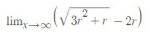
Limit, x -> infy, (sqrt[3r^2 + r] - 2r): tried conjugating but...

joshua772

New member
Joined
Aug 10, 2016
Messages
2
\(\displaystyle \displaystyle \lim_{x\, \rightarrow \, \infty}\, \left(\, \sqrt{\strut 3r^2\, +\, r\, }\, -\, 2r\right)\)

i tried to conjugate but it fails.
can someone help me here.
 

Attachments

  • 1.jpg
    1.jpg
    3.6 KB · Views: 11
Last edited by a moderator:
\(\displaystyle \displaystyle \lim_{x\, \rightarrow \, \infty}\, \left(\, \sqrt{\strut 3r^2\, +\, r\, }\, -\, 2r\right)\)

i tried to conjugate but it fails.
can someone help me here.

You have x → ∞ but there is no 'x' in the function you want to evaluate (it is a function of 'r')
 
Last edited by a moderator:
Well, assuming Subhotosh Khan is correct in his assessment that you made a typo, you really only have two terms to worry about in the limit. The inside of the square root (3r2 + r) obviously goes to infinity as r goes to infinity. It follows that the square root of infinity is still infinity. Now, the second term (2r) also goes to infinity as r goes to infinity. So, you're left with a limit of the form \(\displaystyle \infty - \infty\), which is undefined. However, one of those infinities might be "bigger" than the other - because it grows faster than the other. Now your next step is... how might you determine how fast a particular function grows? Once you know if the functions grow at the same rate or if one grows faster, what can you say about the overall limit?
 
Top