
linear algebra proof help

shelly89

Junior Member
Joined
Oct 17, 2012
Messages
53
Screen Shot 2013-02-20 at 14.22.19.jpg

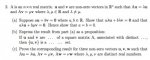
I have attempted part 'a', but have no idead how to do part b or c, any.


\(\displaystyle av + bv = 0 \)

\(\displaystyle a \lambda v + b \lambda v = 0 \)

\(\displaystyle \lambda (au+bv) = \lambda 0 = 0 \)

\(\displaystyle a \lambda u + b \mu v =0 \)

\(\displaystyle a A u + bAv = A (au+bv)= A0 = 0 \)

Is this making any sense?

And can someone please hel me with part b and c?

thank you
 
View attachment 2618

I have attempted part 'a', but have no idead how to do part b or c, any.


\(\displaystyle av + bv = 0 \)
The "given" is supposed to be
au + bv = 0
where a and b are arbitrary constants, and u, v, 0 are vectors.
Since you have the wrong given, the rest of your proof doesn't make sense -
but that may be fixed by replacing v with u in several places.
One branch of the proof is to multiply the given expression by lambda, and the other branch is to multiply by matrix A. You seem to have done that.
\(\displaystyle a \lambda v + b \lambda v = 0 \)

\(\displaystyle \lambda (au+bv) = \lambda 0 = 0 \)

\(\displaystyle a \lambda u + b \mu v =0 \)

\(\displaystyle a A u + bAv = A (au+bv)= A0 = 0 \)

Is this making any sense?

And can someone please hel me with part b and c?

thank you
Part (b) is a proof by negation. You have (presumably) shown that there are no non-zero coefficients that can make au + bv = 0. Look up definitions of eigenvectors and linear independence.
 
err still a bit confused,

for part b, does the proposition go something like this,

if u and v are non-zero vectors of a square matrix A, associated with distint ....distinct arbituary values then {u,v} is a real vector set?
the words in italics, are the words i think fill the gap in the sentence, no sure if this is correct, though?

Also have no idead about part c? any hints?


thank you.
 
Last edited:
err still a bit confused,

for part b, does the proposition go something like this,

if u and v are non-zero vectors of a square matrix A, associated with distint ....distinct arbituary values then {u,v} is a real vector set?
the words in italics, are the words i think fill the gap in the sentence, no sure if this is correct, though?

Also have no idead about part c? any hints?

thank you.
Have you been introduced to eigenvalues and eigenvectors? Better review! Also the concept of linear independence. Those two topics will provide the correct words to fill in the blanks - you haven't found the right words yet!

The clue is to recognize the equation Au = \(\displaystyle \lambda \)u as being the general form of an eigenvalue/eigenvector problem.

As for part (c), WHAT HAVE YOU TRIED? One approach would be to apply the proof of part (a) to the pairs {v, w} and {u, w}. Will that be adequate to prove that au + bv + cw = 0 can only be true if a = b = c = 0?
 
Top