
Hi, I've gotten stuck on this problem and was hoping you could help me.
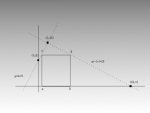
I figured that you can get the point of A by plugging it into the function (4x+5):
A = 4a+5
and then you can express B as A by setting y=-x+15 equal to 4a+5 like so:
4a + 5 = -(b) + 15
4a - 10 = -(b)
B = -4a+10
Then to get the width of AB you subtract the two values and get
(b - a)
-4a+10 - (4a+5)
Width = -8a - 15
However, I'm not sure where to go from here.
Here's a graph showing the two functions and relevant points:Let 0 < X1 < X2 be points on the X-axis. Consider the rectangle ABCD with vertices C and D on the lines given by "y = -x + 15" and "y = 4x + 5" respectively. C and D are the points of intersection with the given lines. Find the maximum area of such a rectangle.
I figured that you can get the point of A by plugging it into the function (4x+5):
A = 4a+5
and then you can express B as A by setting y=-x+15 equal to 4a+5 like so:
4a + 5 = -(b) + 15
4a - 10 = -(b)
B = -4a+10
Then to get the width of AB you subtract the two values and get
(b - a)
-4a+10 - (4a+5)
Width = -8a - 15
However, I'm not sure where to go from here.