Maximum Volume...

rsyed5

New member
Joined
Feb 26, 2014
Messages
10
KP2.JPG
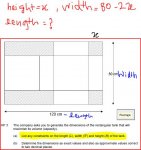
So, I have this question, but I have no idea what constraint is and how to find a constraint for the length, height and width.... and if i say the square wastage is x, then the width is 80-x but I don't know what the length would be with respect to x.... , and how do we determine the dimensions..?
 
View attachment 3853
So, I have this question, but I have no idea what constraint is and how to find a constraint for the length, height and width.... and if i say the square wastage is x, then the width is 80-x but I don't know what the length would be with respect to x.... , and how do we determine the dimensions..?
"Constraints" mean "real-world considerations" such as "can I have negative width?" And so forth. What numbers might work mathematically, but would make no sense in "real life"? ;)
 
say the square wastage is x, then the width is 80-x

Hi. That ought to be 80 - 2x, yes? You subtract x cm from each end of the sheet's width.

Do you understand the diagram? After the shaded areas are cut away from the sheet, the flaps are folded up to form the tank walls, and the longer flap folds over again to form the tank lid.


don't know what the length would be with respect to x


Subtract the amounts for each wall from the length of the sheet. Now divide by two (i.e., multiply by 1/2) because what's left after subtracting the walls is the tank lid and floor.

You'll find the values for L, W, and H by writing a volume function, followed by using the derivative to locate the correct critical point.

Google keywords "maximum volume box calculus" to see similar examples.

Cheers :)
 
"Constraints" mean "real-world considerations" such as "can I have negative width?" And so forth. What numbers might work mathematically, but would make no sense in "real life"? ;)

Thankyou!
 
Hi. That ought to be 80 - 2x, yes? You subtract x cm from each end of the sheet's width.

Do you understand the diagram? After the shaded areas are cut away from the sheet, the flaps are folded up to form the tank walls, and the longer flap folds over again to form the tank lid.


Subtract the amounts for each wall from the length of the sheet. Now divide by two (i.e., multiply by 1/2) because what's left after subtracting the walls is the tank lid and floor.

You'll find the values for L, W, and H by writing a volume function, followed by using the derivative to locate the correct critical point.

Google keywords "maximum volume box calculus" to see similar examples.

Cheers :)

Thank you, yep that was 8-2x
 
Top