Means and tangents (proofs)

rhombuster

New member
Joined
Mar 1, 2015
Messages
8
if f(x) = sqrt(x), show that c = sqrt(ab), the geometric mean of a and b, for a > 0 and b > 0
2 points: P(a, f(a)) and Q(b, f(b)), c is the x value of the intersect between P and Q. This is the value I need to find.

Here's where I'm at so far:
d/dx(sqrt(x)) = 1/2sqrt(x) = m(slope)

I need to find the values of x and y for the 2 lines to create linear equations:
Starting with P: x values = a, y values = f(a) (which = sqrt(a))
Plug in the values to create an equation using y = mx+b

y = 1/2sqrt(x-a) + sqrt(a)

Now equation for Q, steps are the same so:
y = 1/2sqrt(x-b) + sqrt(b)

I'm pretty sure this is wrong, I can't solve for x to get x = sqrt(ab).

I'm really lost, the help centre at my school was told not to help with anything other than basic explanations(I was given advice that didn't work) and my prof takes forever to answer emails. I'd appreciate anyone taking time to point out where I went wrong.
 
if f(x) = sqrt(x), show that c = sqrt(ab), the geometric mean of a and b, for a > 0 and b > 0
How is "c" defined? Is it maybe the "c" from the one theorem about a point on the interval having the same slope as the average slope for the entire interval?

2 points: P(a, f(a)) and Q(b, f(b)), c is the x value of the intersect between P and Q. This is the value I need to find.
What do you mean by the "intersect" "between" the two listed points? (Lines intersect, but points do not. Also, intersections are "of" two lines, not "between" two lines. So clearly I'm not understanding what the exercise is asking here.)

Thank you! ;)
 
if f(x) = sqrt(x), show that c = sqrt(ab), the geometric mean of a and b, for a > 0 and b > 0
2 points: P(a, f(a)) and Q(b, f(b)), c is the x value of the intersect between P and Q. This is the value I need to find.

Here's where I'm at so far:
d/dx(sqrt(x)) = 1/2sqrt(x) = m(slope)

I need to find the values of x and y for the 2 lines to create linear equations:
Starting with P: x values = a, y values = f(a) (which = sqrt(a))
Plug in the values to create an equation using y = mx+b

y = 1/2sqrt(x-a) + sqrt(a)

Now equation for Q, steps are the same so:
y = 1/2sqrt(x-b) + sqrt(b)

I'm pretty sure this is wrong, I can't solve for x to get x = sqrt(ab).

I'm really lost, the help centre at my school was told not to help with anything other than basic explanations(I was given advice that didn't work) and my prof takes forever to answer emails. I'd appreciate anyone taking time to point out where I went wrong.
You have put you equations for the tangent lines together incorrectly. Let's take point a
y = f(a) + f'(a) (x-a)
f(a) = \(\displaystyle \sqrt{a}\)
f'(a) = \(\displaystyle \frac{1}{2 \sqrt{a}}\)
so line P(a, f(a)) is
y = \(\displaystyle \sqrt{a} + \frac{1}{2 \sqrt{a}} (x-a)\)
 
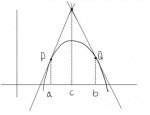
Here is the entire question, including a rough sketch of the example graph.

Suppose f is differentiable on an interval containing a and b, and let P(a, f(a)) and Q(b, f(b)) be distinct points on the graph of f. Let c be the x-coordinate of the point at which the lines tangent tot he curve at P and Q intersect, assuming that the tangent lines are not parallel.


asdasd.jpg
That's a rough drawing of the example graph(This obviously isnt sqrt(x)). Here's the question:
if f(x) = sqrt(x), show that c = sqrt(ab), the geometric mean of a and b, for a > 0 and b > 0
 
Here is the entire question, including a rough sketch of the example graph.

Suppose f is differentiable on an interval containing a and b, and let P(a, f(a)) and Q(b, f(b)) be distinct points on the graph of f. Let c be the x-coordinate of the point at which the lines tangent tot he curve at P and Q intersect, assuming that the tangent lines are not parallel.


View attachment 5101
That's a rough drawing of the example graph(This obviously isnt sqrt(x)). Here's the question:
if f(x) = sqrt(x), show that c = sqrt(ab), the geometric mean of a and b, for a > 0 and b > 0
c is an x-value while sqrt(ab) is a y-value. My gut feeling is that this statement is not true.
 
c is an x-value while sqrt(ab) is a y-value. My gut feeling is that this statement is not true.
Look at the tangent line above for point A in my previous post
\(\displaystyle y=\sqrt{a} + \frac{1}{2 \sqrt{a}} (x-a)\).
Now write the tangent line for point b. Find at what x value they intersect. That x value is \(\displaystyle \sqrt{ab}\)
 
Look at the tangent line above for point A in my previous post
\(\displaystyle y=\sqrt{a} + \frac{1}{2 \sqrt{a}} (x-a)\).
Now write the tangent line for point b. Find at what x value they intersect. That x value is \(\displaystyle \sqrt{ab}\)
OK, you motivated me to try the problem and it is true. Thanks!
 
Top