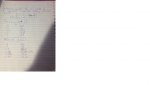
My piecewise function answer

Alexmcom

New member
Joined
Jun 27, 2016
Messages
27
sorry I had to quickly edit my photo since I just realized I made a mistake.

Anyways hey everyone - I have a piecewise function where 5x^2-3, x < -2 and 4x+25 , x > -2.


These are my calculations. Basically I am trying to see if there is a limit or not. With the 5x^2-3 I see the limit is 17 right. For the function 4x+25 the limit is approaching 17 but never hits the mark(it hits 17.004) and if we plug in the x axis an infinite amount of 1.999999999 it will still equal to something like 17.0000004. Can I say that 4x+25 still has no limit since it never approaches 17?

Overall I want to say that there is no limit for the function since both functions have different final outcomes. What I mean is that 5x^2-3 has a limit at -2 which is 17. But the answer is different for 4x+25...it states that 17.004 never reaches 17 in the end.
 

Attachments
  • photo.JPG
    photo.JPG
    88.1 KB · Views: 3
Last edited:
sorry I had to quickly edit my photo since I just realized I made a mistake.

Anyways hey everyone - I have a piecewise function where 5x^2-3, x < -2 and 4x+25 , x > -2.
As written that is not a real function because it is not defined for \(\displaystyle x=-2 \)
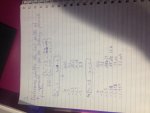
Moreover, I refuse to cairn my neck trying to see your attachment. Please try to do better.

Consider this function: \(\displaystyle {f(x)=\begin{cases}5x^2-3 &\: x<-2\\25 & x=-2\\4x+25 &\: x>-2\end{cases}}\) That function is defined for all \(\displaystyle x\)

Now \(\displaystyle \displaystyle{\lim _{x \to - {2^ - }}}f(x) = 17\) AND \(\displaystyle \displaystyle{\lim _{x \to - {2^ + }}}f(x) = 17\) therefore \(\displaystyle \displaystyle{\lim _{x \to - {2 }}}f(x) = 17\) BUT \(\displaystyle \displaystyle{\lim _{x \to - {2 }}}f(x) \ne f(-2)\)
 
As written that is not a real function because it is not defined for \(\displaystyle x=-2 \)
Moreover, I refuse to cairn my neck trying to see your attachment. Please try to do better.

Consider this function: \(\displaystyle {f(x)=\begin{cases}5x^2-3 &\: x<-2\\25 & x=-2\\4x+25 &\: x>-2\end{cases}}\) That function is defined for all \(\displaystyle x\)

Now \(\displaystyle \displaystyle{\lim _{x \to - {2^ - }}}f(x) = 17\) AND \(\displaystyle \displaystyle{\lim _{x \to - {2^ + }}}f(x) = 17\) therefore \(\displaystyle \displaystyle{\lim _{x \to - {2 }}}f(x) = 17\) BUT \(\displaystyle \displaystyle{\lim _{x \to - {2 }}}f(x) \ne f(-2)\)


attachment.php
hopefully you can see this one correctly; the site made it a bit harder and changed the original photo.
 

Attachments

  • photo correct.jpg
    photo correct.jpg
    60.7 KB · Views: 13
As written that is not a real function because it is not defined for \(\displaystyle x=-2 \)
Moreover, I refuse to cairn my neck trying to see your attachment. Please try to do better.

Consider this function: \(\displaystyle {f(x)=\begin{cases}5x^2-3 &\: x<-2\\25 & x=-2\\4x+25 &\: x>-2\end{cases}}\) That function is defined for all \(\displaystyle x\)

Now \(\displaystyle \displaystyle{\lim _{x \to - {2^ - }}}f(x) = 17\) AND \(\displaystyle \displaystyle{\lim _{x \to - {2^ + }}}f(x) = 17\) therefore \(\displaystyle \displaystyle{\lim _{x \to - {2 }}}f(x) = 17\) BUT \(\displaystyle \displaystyle{\lim _{x \to - {2 }}}f(x) \ne f(-2)\)


So basically it does equal to 17 if I am reading this correctly. But f(x) does not equal to f(-2)
So I can conclude that there is a limit. Sorry if I am misunderstanding.
 
Last edited:
So basically it does equal to 17 if I am reading this correctly. But f(x) does not equal to f(-2)
So I can conclude that there is a limit. Sorry if I am misunderstanding.
Yes there is a limit but it is not \(\displaystyle f(-2)\) as I defined it.
 
To be specific, there is a limit (that is, there is a value that the function ought to take on) at x = -2. But the function is not defined at x = -2, so the function is not continuous (that is, the function doesn't take on the value that, by all rights, it ought to). ;)
 
Top