
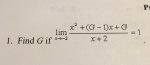
Need help solving for G in lim[x -> -2] [(x^2 + (G-1)x + G) / (x + 2)] = 1

jtstien

New member
Joined
Feb 4, 2016
Messages
5
I have a math problem(attached) in which I need to solve for G given the limit information.

. . . . .\(\displaystyle \mbox{Find }\, G\, \mbox{ if }\, \)\(\displaystyle \displaystyle \lim_{x\, \rightarrow\, -2}\, \)\(\displaystyle \dfrac{x^2\, +\, (G\, -\, 1)\,x\, +\, G}{x\, +\, 2}\, =\, 1\)

I'm having trouble starting the problem or figuring out which direction to go with it. I know I need to manipulate it until I can substitute -2 in and solve but can't figure out how.
 

Attachments
  • Math Problem.JPG
    Math Problem.JPG
    141.6 KB · Views: 2
Last edited by a moderator:
I have a math problem(attached) in which I need to solve for G given the limit information. I'm having trouble starting the problem or figuring out which direction to go with it. I know I need to manipulate it until I can substitute -2 in and solve but can't figure out how.


attachment.php


What will be the value of G if you wanted:

x2 + (G-1)x + G = (x + 2)(x + 3)
 
I have a math problem(attached) in which I need to solve for G given the limit information.

. . . . .\(\displaystyle \mbox{Find }\, G\, \mbox{ if }\, \)\(\displaystyle \displaystyle \lim_{x\, \rightarrow\, -2}\, \)\(\displaystyle \dfrac{x^2\, +\, (G\, -\, 1)\,x\, +\, G}{x\, +\, 2}\, =\, 1\)

I'm having trouble starting the problem or figuring out which direction to go with it. I know I need to manipulate it until I can substitute -2 in and solve but can't figure out how.
Or another way: Do a division by x+2. What does G have to be to have a zero remainder.
 
. . . . .\(\displaystyle \mbox{Find }\, G\, \mbox{ if }\, \)\(\displaystyle \displaystyle \lim_{x\, \rightarrow\, -2}\, \)\(\displaystyle \dfrac{x^2\, +\, (G\, -\, 1)\,x\, +\, G}{x\, +\, 2}\, =\, 1\)
From having worked other exercises, you know that this sort of rational-expression sort of limit works out nicely if the numerator factors, so you end up with something that cancels off. In this case, if you could get a factor of x + 2 on top, then this would cancel off with the denominator, and you'd no longer have a division-by-zero issue. This was the point of this hint:

What will be the value of G if you wanted:

x2 + (G-1)x + G = (x + 2)(x + 3)
In order to figure out what we'd need G to be in order to get the factorization we want, we can take a shortcut. We can divide by the factor that we're wanting to have divide out. In order for this "x + 2" to be a factor on top, it must be that, when we divide the numerator by x + 2, we end up with a zero remainder. This was the point of this hint:

Or another way: Do a division by x+2. What does G have to be to have a zero remainder.
So do the long polynomial division (here), set the remainder (in terms of G) equal to (the desired value of) zero, and solve for the requested value of G.

If you get stuck, please reply showing your steps so far. Thank you! ;)
 
I have a math problem(attached) in which I need to solve for G given the limit information.

. . . . .\(\displaystyle \mbox{Find }\, G\, \mbox{ if }\, \)\(\displaystyle \displaystyle \lim_{x\, \rightarrow\, -2}\, \)\(\displaystyle \dfrac{x^2\, +\, (G\, -\, 1)\,x\, +\, G}{x\, +\, 2}\, =\, 1\)erator by

I'm having trouble starting the problem or figuring out which direction to go with it. I know I need to manipulate it until I can substitute -2 in and solve but can't figure out how.
Hi, Subhotosh gave the best hint. I will try to motivate the hint. I am sure that you see that the denominator is 0 when x=-2. So you want to cancel off that 0 by putting a (x+2) in the numerator. So far this fraction (x+2)/(x+2) is identically 1 (if x is not -2). This gives you the limit that you want but the numerator is a quadratic as the coefficient of x^2 is not 0, it is 1. So you need another factor for the numerator. Since the numerator is linear and you want a quadratic then multiple (x+2) in the numerator by (x+a). This will give us a quadratic with 1 as the coefficient of x^2. So what is a equal to? Since 1*1 = 1 we want (x+a)=1 when x=-2. Since (-2+3) =1 we have a=3. Now the numerator is (x+2)(x+3). Multiply this out and then try to figure out what g equals. Nice problem.
 
I have a math problem(attached) in which I need to solve for G given the limit information.
. . . . .\(\displaystyle \mbox{Find }\, G\, \mbox{ if }\, \)\(\displaystyle \displaystyle \lim_{x\, \rightarrow\, -2}\, \)\(\displaystyle \dfrac{x^2\, +\, (G\, -\, 1)\,x\, +\, G}{x\, +\, 2}\, =\, 1\)
Since we seem to be beating a dead horse, I might add a lick.

Solving \(\displaystyle (-2)^2+(G-1)(-2)+G=0\) is solve the question. WHY?
 
Since we seem to be beating a dead horse, I might add a lick.

Solving \(\displaystyle (-2)^2+(G-1)(-2)+G=0\) is solve the question. WHY?
and again
\(\displaystyle \frac{x^2\, +\, (G-1)\, x\, + G}{x\, +\, 2}\)
Synthetic division
Code:
[FONT=courier new]     |  1      G-1         G
-2   |          -2     -2(G-3)
     |_____________________________
     |  1      G-3       -G+6[/FONT]
So
\(\displaystyle \frac{x^2\, +\, (G-1)\, x\, + G}{x\, +\, 2} = (x\, +\, G-3)\, +\, \frac{6-G}{x+2}\)
How do you make the remainder zero?
 
Top