
Directional Derivative exercise (help, please)
Hello, I'm not new in the forum, but I've just use it once, and it's been a long time, so please excuse me and correct me if the format of my question is wrong or something.
This is the exercise:
Consider the surface \(\displaystyle \, S:\, x^2 y z\, -\, z^2 x\, =\, z y\)
\(\displaystyle P\, =\, (0,\, -1,\, 0)\)
Find \(\displaystyle \, D\, \underset{u}{\rightarrow}\, z(P)\)
if: \(\displaystyle \, \overrightarrow{u}\, =\, (2,\, -3)\)
I can calculate the gradient just fine (I think):
\(\displaystyle \nabla\, f(x,\, y,\, z)\, =\, (2xyz\, -\, z^2,\, x^2z\, -\, z,\, x^2 y\, -\, 2xz\, -\, y)\)
where \(\displaystyle \, f(x,\, y,\, z)\, =\, x^2 y z\, -\, z^2 x\, -\, zy\, =\, 0\)
and I now that I need to make u a unit vector, because the Partial Derivative is:
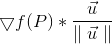
\(\displaystyle \nabla\, f(P)\, *\, \dfrac{\overrightarrow{u}}{\Vert \, \overrightarrow{u}\, \Vert}\)
right?
Now the question is, how I'm suppose to use the dot product between a vector (x,y,z) and a vector with just (x,y) ?
Is there something that I'm missing here?
Any help, I'd appreciate it.
Hello, I'm not new in the forum, but I've just use it once, and it's been a long time, so please excuse me and correct me if the format of my question is wrong or something.
This is the exercise:
Consider the surface \(\displaystyle \, S:\, x^2 y z\, -\, z^2 x\, =\, z y\)
\(\displaystyle P\, =\, (0,\, -1,\, 0)\)
Find \(\displaystyle \, D\, \underset{u}{\rightarrow}\, z(P)\)
if: \(\displaystyle \, \overrightarrow{u}\, =\, (2,\, -3)\)
I can calculate the gradient just fine (I think):
\(\displaystyle \nabla\, f(x,\, y,\, z)\, =\, (2xyz\, -\, z^2,\, x^2z\, -\, z,\, x^2 y\, -\, 2xz\, -\, y)\)
where \(\displaystyle \, f(x,\, y,\, z)\, =\, x^2 y z\, -\, z^2 x\, -\, zy\, =\, 0\)
and I now that I need to make u a unit vector, because the Partial Derivative is:
\(\displaystyle \nabla\, f(P)\, *\, \dfrac{\overrightarrow{u}}{\Vert \, \overrightarrow{u}\, \Vert}\)
right?
Now the question is, how I'm suppose to use the dot product between a vector (x,y,z) and a vector with just (x,y) ?
Is there something that I'm missing here?
Any help, I'd appreciate it.
Attachments





Last edited: