M MAM New member Joined Feb 4, 2012 Messages 6 Mar 10, 2012 #1 Find a point at which the surface given by F(x,y) = x2 + 3x + y2 - 4y + 7 is neither rising nor falling in either the x- or the y-direction.
Find a point at which the surface given by F(x,y) = x2 + 3x + y2 - 4y + 7 is neither rising nor falling in either the x- or the y-direction.
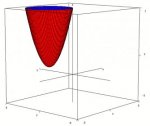
P pappus Junior Member Joined Feb 13, 2012 Messages 220 Mar 11, 2012 #2 MAM said: Find a point at which the surface given by F(x,y) = x2 + 3x + y2 - 4y + 7 is neither rising nor falling in either the x- or the y-direction. Click to expand... Use partial differentiation: \(\displaystyle \displaystyle{\frac{\partial F}{\partial x} = 2x+3}\) and \(\displaystyle \displaystyle{\frac{\partial F}{\partial y} = 2y-4}\) Both derivatives must equal zero. Solve for x and y. Plug in these values into F to get the value of the z-coordinate. Check if you've found a maximum point or a minimum point. For confirmation only I've attached the graph of the function. Attachments paraboloidminim.jpg 13.8 KB · Views: 0 Last edited: Mar 11, 2012
MAM said: Find a point at which the surface given by F(x,y) = x2 + 3x + y2 - 4y + 7 is neither rising nor falling in either the x- or the y-direction. Click to expand... Use partial differentiation: \(\displaystyle \displaystyle{\frac{\partial F}{\partial x} = 2x+3}\) and \(\displaystyle \displaystyle{\frac{\partial F}{\partial y} = 2y-4}\) Both derivatives must equal zero. Solve for x and y. Plug in these values into F to get the value of the z-coordinate. Check if you've found a maximum point or a minimum point. For confirmation only I've attached the graph of the function.