
polynomials

Mond from Oz

New member
Joined
Apr 20, 2011
Messages
4
A. I think I just lost a lovingly crafted first post. But if it did go through to you, please excuse this duplication. B. I'm 79 years old and very new to calculus. Please go easy on me.

With permission from NOAA and Dr Pieter Tans, I have downloaded the atmosphertic CO2 concentration data since 1958 from Moana Lua (Hawaii). I have fitted a curve to the data.
the formula is: y = 0.0122x^2 + 0.7867x + 313.71. That is, at x = 0 (1958), the concentration of CO2 was 313.71 ppm. (the fit, btw, was great: R^2 = 0.9991). The rate of increase is indicated by: y' 1958 = 1.031; y' 1988 = 1.519; y' 2008 = 2.007. The increase in that value is described by y'' = 0.024.

But I think I need a y''' in there. What precisely would that tell me? How do I calculate y'''? And if I take a particular value of x, how do I calculate the doubling time in y from that value of x?

I hope these are appropriate questions.
Regards from sunny Sydney,
Mond
 
The second difference (or derivative for your fitted model) is a wonderful thing. I believe its first appearance in the public sector was when Richard Nixon announced "The rate of increase of inflation is going down." He wanted so hard to say something like "decreasing"! Not quite. This means, it's still going up, but not quite as fast as it was a while ago.

Your 2nd degree polynomial can't do this. It has a constant second derivative. In your model, this suggests the rate at which CO2 concentration is changing is constant. If it goes up at a rate of 5/year today, it can't go up at a rate of 6/year tomorrow, it will be 5/year again.

Of course, however good your fit, this is unlikely to be a valid predictive model.
1) It assumes we just happened to start watching right around the absolute minimum levels ever.
2) Eventually, the concentration will start to kill off humans and we won't be able to produce as much.

Good work.
 
Mond from Oz said:
A. I think I just lost a lovingly crafted first post. But if it did go through to you, please excuse this duplication. B. I'm 79 years old and very new to calculus. Please go easy on me.

With permission from NOAA and Dr Pieter Tans, I have downloaded the atmosphertic CO2 concentration data since 1958 from Moana Lua (Hawaii). I have fitted a curve to the data.
the formula is: y = 0.0122x^2 + 0.7867x + 313.71. That is, at x = 0 (1958), the concentration of CO2 was 313.71 ppm. (the fit, btw, was great: R^2 = 0.9991). The rate of increase is indicated by: y' 1958 = 1.031; y' 1988 = 1.519; y' 2008 = 2.007. The increase in that value is described by y'' = 0.024.

But I think I need a y''' in there. What precisely would that tell me? How do I calculate y'''? And if I take a particular value of x, how do I calculate the doubling time in y from that value of x?

I hope these are appropriate questions.
Regards from sunny Sydney,
Mond
tkhunny (as always) has given you a very good answer.

Just a few points. y''' is the third derivative: it is the rate of increase in the rate of increase of the rate of increase. Derivatives higher than the second have a restricted domain of practical applicability. In any case, the third derivative of every quadratic is 0 everywhere so it cannot mean much with respect to any specific quadratic.

I am concerned about how you fit your points. It is possible to read your question as implying that you used just three data points to develop your quadratic. That is an invalid technique because three points define a unique quadratic just as two points define a unique straight line. If in fact you used 51 data points and got an R[sup:3di69e04]2[/sup:3di69e04] of 99.91%, that is an excellent result. If, however, you used three data points, the R[sup:3di69e04]2[/sup:3di69e04] is meaningless. It is not 100% only because of rounding errors in the fitting process.
 
Thanks TKH and Jeff M.
Can you please clarify the comment "if it goes up at a rate of 5/yr today, it cant go up at a rate of 6/yr tomorrow..." I realise that y'' is a constant (2a), but surely that just shows that the rate of increase of the rate of increase is ??linear. Also, I'm having trouble with point 1. (TKH) I don't believe I am making that assumption. As to 2., yes, well that's the point, isn't it?

And Jeff, yes, I calculated all 51 yearly means and SDs from the monthly data, and then fitted the 51 points. Using Excel its no big deal. But guys, to go back to my original post, how do I calculate doubling time on an accelerating curve?

Thanks
Mond
 
Mond from Oz said:
Thanks TKH and Jeff M.
Can you please clarify the comment "if it goes up at a rate of 5/yr today, it cant go up at a rate of 6/yr tomorrow..." I realise that y'' is a constant (2a), but surely that just shows that the rate of increase of the rate of increase is ??linear. Also, I'm having trouble with point 1. (TKH) I don't believe I am making that assumption. As to 2., yes, well that's the point, isn't it?

And Jeff, yes, I calculated all 51 yearly means and SDs from the monthly data, and then fitted the 51 points. Using Excel its no big deal. But guys, to go back to my original post, how do I calculate doubling time on an accelerating curve?

Thanks
Mond

Let me make sure I understand the question and notation.

y(x) = the monthly average concentration of CO[sub:1my9nie5]2[/sub:1my9nie5] during year x, where x is the year according to the Gregorian calendar minus 1958.

y(x) = .0122x[sup:1my9nie5]2[/sup:1my9nie5] + .7867x + 313.71.
y'(x) = .0244x + .7867.

Are you asking for the year w such that y(w - 1958 + 1) = 2 * y(w - 1958)? Or are you asking a more subtle question? Sorry to be dense.
 
You should try to let go of some notions.

Don't let the rate of change being linear bother you. It is what it is. If you really believe the model, who cares what the implications are? This is the sort of thing that causes new information to come to light because of the model. It is often why we build models at all!

It's only a model. The fact that your R^2 is very large does NOT mean that you have revealed the golden thread of life and exposed the true relationship. It's just a model.

If the rate of increase is linear, the rate of increase of the rate of increase is, indeed, linear, but it is a special case of linear called "constant". The rate of increase of a constant is zero, of course. That's also linear and a constant.

As for your assumptions:
1) My comment applies ONLY to using this as a predictive model into the past. If you never look that direction, no one will care what you are or are not assuming. I'm just looking at the model. If you are not comfortable with the implicit assumption I have suggested, you have a choice, either never use it as a model predictive of the past or change your model.
2) "That's the point, isn't it" -- This is a socially dangerous statement. If you want to produce a useful model, with rational implications, you cannot start with this attitude. This is where we get "Junk Science". It needs not to occur. You must get it out of your head if you wish to continue usefully.

Now for doubling time. Do you think that doubling time should be constant? In other words, should the doubling time from 1960 be the same as doubling time from 1980? How about from 2000? This is a very important question. Careful with your answer. If you say "yes", you must discard your present quadratic model and start over with an exponential model. If you REALLY like this quadratic model, particularly because your R^2 is so high, you'll have to say "no".
 
Hi TKH and Jeff

TKH - I am not bothered by the rate of change being linear, because as I understand it, it isn't linear. That is indicated by inspection, and by the systematic increase in y' The rate of change of the rate of change (y'') is linear. Isn't that right?

Second, I am not mesmerized in admiration of R^2. I well understand it to be a measure of the amount of variance in the data which is predicted or described by the model.

Third, I am aware of the historical and paleoclimatic trends in CO2 concentration. The pre-industrial level was stable around 288ppm.

Fourth, as to "that's the point..." you wrote "eventually the concentration will start to kill off humans" and I agreed, saying "that's the point" But your point. I recognise 'junk science' when I see it, and I don't do it.

Fifth, Given that the function is a quadratic, with the rate of change increasing, wont the doubling time fro - say - 1958 be longer than from 2008?

And Jeff, my x axis is labelled andin steps of ten from zero. Zero equates to 1958, 10 is 1968, etc. As to subtlety, I dunno. But isn't the doubling time from a point on the x axis a function not just of the value of y at that point, but also of the rate of change FROM that point. That is what I am trying to understand and calculate. BIG thanks to both of you.
Mond
 
Rate of Change. Not, it IS linear.

y'(x) = .0244x + .7867.

Very much linear.

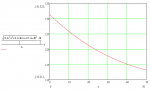
Anyway, given y(x) = Ax^2 + Bx + C, and given an initial point, x0, we seek an additional point such that y(x1) = 2*y(x0). "Doubling Time", then is x1 - x0.

This is just a quadratic solution \(\displaystyle x_{1} = \frac{\sqrt{8A^{2}x_{0}^{2} + 8ABx_{0} + 4CA + B^2} - B}{2\cdot A}\)

This leads to the attached graph, given your values for A, B, and C.
 

Attachments

  • Quadratic Doubling.png
    Quadratic Doubling.png
    10.8 KB · Views: 133
Mond from Oz said:
Hi TKH and Jeff

Hi Mond. It is late here. I am very sleepy, and I have things to attend to in the morning. I'll check back in twelve or fourteen hours. Just a few comments.

TKH - I am not bothered by the rate of change being linear, because as I understand it, it isn't linear. That is indicated by inspection, and by the systematic increase in y' The rate of change of the rate of change (y'') is linear. Isn't that right? No. The rate of change of a proper quadratic is always increasing linearly or decreasing linearly. You seem to think that "linear" means "neither increasing nor decreasing." All linear means is that the rate of change when graphed is a straight line, but in a proper quadratic it is never a horizontal line. Of course the second derivative of a quadratic is also linear, but it is neither increasing nor decreasing: it is horizontal.
Second, I am not mesmerized in admiration of R^2. I have two thoughts about that R[sup:3vi9av4k]2[/sup:3vi9av4k]. First, if the data have not been smoothed or adjusted somehow before you got them and if excel's stat package is working right, you have a VERY robust model for at least the last 50 years. Second, the R[sup:3vi9av4k]2[/sup:3vi9av4k] is almost too good to be true. Empirical data seldom are that perfect. I'd be cautious and do a lot of checking and cross checking.

I well understand it to be a measure of the amount of variance in the data which is predicted or described by the model.

Third, I am aware of the historical and paleoclimatic trends in CO2 concentration. The pre-industrial level was stable around 288ppm.

Fourth, as to "that's the point..." you wrote "eventually the concentration will start to kill off humans" and I agreed, saying "that's the point" But your point. I recognise 'junk science' when I see it, and I don't do it.

Fifth, Given that the function is a quadratic, with the rate of change increasing, wont the doubling time fro - say - 1958 be longer than from 2008?

And Jeff, my x axis is labelled andin steps of ten from zero. Zero equates to 1958, 10 is 1968, etc. As to subtlety, I dunno. But isn't the doubling time from a point on the x axis a function not just of the value of y at that point, but also of the rate of change FROM that point. NOT QUITE. Assuming I have got my mind around what you mean by doubling time, it is influenced by the rate of change at every point from the inital to the doubled point. FORTUNATELY, as tkhunny points out, you can ignore the rate of change at that infinitude of points because you already have an equation for y(x). You can use algebra, which will undoubtedly be computationally messy but is conceptually simple, to find the doubling period from any starting point.

That is what I am trying to understand and calculate. BIG thanks to both of you. You're welcome.
Mond
 
TKH

The shame....the shame.
TKH, I apologise (very.. sincerely) for arguing about linearity. Looking at the formula for y', of course its linear. It's just that it's kinda counter intuitive when the graph for the data goes up in that nice curve.. But that's no excuse. And thanks for the formula for doubling time, and the graph- I'll use that to check my workings.
ATB
Mond
 
No worries. I appreciate your ability to hang in the discussion.

Just don't bring up worldwide oil consumption. I can get a little hostile on bad models about that. :evil:
 
Top