
prime numbers pattern

RossB

New member
Joined
Jan 26, 2020
Messages
1
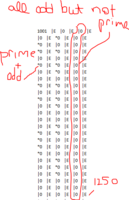
I think I have discovered a possible new pattern with prime numbers, after 100 every 6 th odd number will not be a prime see the attachment
In the attached file are all the numbers between 1001 and 1250 shown as primes with an asterisk , odd (O) and even (E)

I have done all the numbers between 100 and 1000 and got the same result. I have done all the numbers between 1000 and 2000 and got the same result

every 6th odd number will not be a prime so after 1000 the sixth odd will be 1005, 1011,1017,1023 etc etc ...none of these will be primes
 

Attachments

  • aodd44.PNG
    aodd44.PNG
    21.5 KB · Views: 4
every 6th odd number will not be a prime so after 1000 the sixth odd will be 1005, 1011,1017,1023 etc etc ...none of these will be primes
What you list are not "every 6th odd number", but "every 6th number starting at 1005". In any case, it's easy to prove, in the same manner as Halls' answer. Have you tried?
 
I think I have discovered a possible new pattern with prime numbers, after 100 every 6 th odd number will not be a prime see the attachment
In the attached file are all the numbers between 1001 and 1250 shown as primes with an asterisk , odd (O) and even (E)

I have done all the numbers between 100 and 1000 and got the same result. I have done all the numbers between 1000 and 2000 and got the same result

every 6th odd number will not be a prime so after 1000 the sixth odd will be 1005, 1011,1017,1023 etc etc ...none of these will be primes
You are reporting an observation where the numbers are NOT prime, according to some "observed rule". That is good but not very interesting in the math-arena. As you saw that "observed rule" can be proven easily and be (has been) generalised.

However, on the other hand if you make an observation, where the numbers ARE prime, according to some "observed rule" - that will be very interesting.
 
Just because you showed something is true up to 2000 it does not mean that is it true for all numbers
A quick silly example. 5,245 does not go evenly into any integer from 1 to 2000 so it therefore does not go into any integer. Is that a valid statement? Or does 5245 go evenly into 5245 and evenly into 10,490?
 
Top