Probability and Statistics

lucyle992

New member
Joined
Jan 17, 2021
Messages
13
You work at Mile's pizza shop. You have the following information about the 7 pizzas in the oven: 3 of the 7 have thick crust and 2 of the 3 thick-crust pizzas have mushrooms. Of the remaining 4 pizzas, 2 have mushrooms. Choose a pizza at random from the oven. Make a Venn diagram to model this chance process.

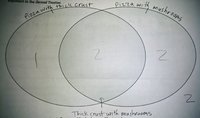
Here is a photo of my Venn diagram. Is this correct?
 

Attachments

  • 0206210046.jpg
    0206210046.jpg
    3.3 MB · Views: 10
Sorry your Venn diagram isn't quite correct. You labelled the two circular sets with "Thick crust" and "Not thick crust". This is not necessary, you just need to label one of the circles as "Thick crust" and then everything outside of that circle will automatically be "not a thick crust". The other circle should just be labelled "with mushrooms", and then everything outside of that circle won't have any mushrooms. The intersection of the two circles will then represent thick crust with mushrooms.

Please have another go at drawing the diagram and post back if you'd like us to check.
 
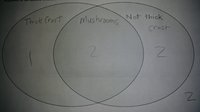
Here is the new Venn diagram. Can someone check it please. Also, can I get some help in checking the next question, part b?
a) Make a Venn Diagram
b) Are the events "getting a thick-crust pizza" and "getting a pizza with mushrooms" independent:
Let T= "getting a thick crust pizza" and Let M= "getting a pizza with mushrooms.

Her is my answer for part b.
P(T|M) = P(T) = 1/2 = 0.5 = 3/7 = 0.428571
P(M|T) = P(M) = 2/3 = 0.66 = 4/7 = 0.571428

The events are dependent, because 1/2 doesn't equal 3/7 and 2/3 doesn't equal 4/7.
 

Attachments

  • 0206211427.jpg
    0206211427.jpg
    5.2 MB · Views: 14
Yes your new diagram is correct and better.
Those two are dependent,
Here is the way I would show it:
\(\mathcal{P}(M\cap TC)\ne \mathcal{P}(M)\cdot\mathcal{P}(CT)\)
 
Her is my answer for part b.
P(T|M) = P(T) = 1/2 = 0.5 = 3/7 = 0.428571
P(M|T) = P(M) = 2/3 = 0.66 = 4/7 = 0.571428
I think you mean the right thing, but what you wrote is nonsense. In fact, your whole point is that these are not all equal, but you said they are!

You are using the idea that events M and T are independent if and only if P(T|M) = P(T); that is, if the probability of T is unaffected by M. So calculate both separately:

P(T|M) = 2/4 = 1/2 = 0.5​
P(T) = 3/7​

These are not equal, so the events are not independent. (You don't have to also compare P(M|T) and P(M).)

pka's version is equivalent, and perhaps a little simpler; you should use the method you have been taught, but it's good to be aware of both.
 
Top