Given f(x) =
a(x + 2) (1<= x <=2)
b(x + 1) (-1 <= x <= 1)
0 (any other condition)
(1) Find the condition of a and b that makes f(x) a probability density function.
(2) Let X be the continuous probability variable of probability density function f(x).
If expectation (=average) = 2, please find variance V(X).
-------------------------------------------
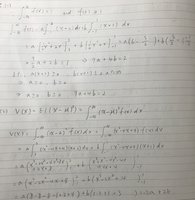
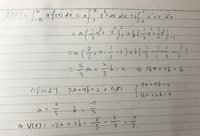
I solve the questions as shown on the attach files.
And the answer is
(1) 7a+4b=2 and a>=0, b>=0
(2) V(X) =4/5
Can anyone kindly let me know if it is correct or there is anything I got wrong?
Especially for (2).
While I use another approach to get variance: V(X) = E(X^2)-E(X)^2
with the value of a and b shown in the picture, the answer is different (not 4/5).
Is there something wrong?
a(x + 2) (1<= x <=2)
b(x + 1) (-1 <= x <= 1)
0 (any other condition)
(1) Find the condition of a and b that makes f(x) a probability density function.
(2) Let X be the continuous probability variable of probability density function f(x).
If expectation (=average) = 2, please find variance V(X).
-------------------------------------------
I solve the questions as shown on the attach files.
And the answer is
(1) 7a+4b=2 and a>=0, b>=0
(2) V(X) =4/5
Can anyone kindly let me know if it is correct or there is anything I got wrong?
Especially for (2).
While I use another approach to get variance: V(X) = E(X^2)-E(X)^2
with the value of a and b shown in the picture, the answer is different (not 4/5).
Is there something wrong?