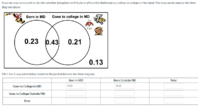
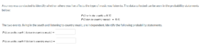
No wonder you are confused. The problem is horribly posed.
The probabilities presumably represent relative frequencies, but nothing in the Venn diagram explicitly discloses that. Relative to what? You are not told. You are indeed provided with a map of Maryland as well as a cartoon of a terrapin, which provide no help at all. Venn diagrams are supposed to help you understand rather than pose a puzzle that provides irrelevancies while suppressing relevancies such as the underlying population. In the real world, you are expected to make displays meaningful to your audience. Meaning is the purpose of descriptive statistics. If no one knows what population is being discussed, no one can assess the meaning of frequencies in that population.
Well you must deal with the clowns that are supposed to educate people. Let's try to figure out what silly game is being played.
The lowest, rightmost cell is supposed to tell you what percentage of the total population is the total population. That's 100% obviously. Why include that obvious number at all? Because it allows you to catch mistakes. Both the numbers above it and the numbers to its left need to add to 100%. If they do not, you have made one or more mistakes.
Do our numbers add up to 1 (since they are using fractions rather than percents as is more usual).
0.23 + 0.43 + 0.21 + 0.13 = 1.00.
Now all you have to do is figure out in which box to put each number. Is 0.13 included in the circle of those going to college in Maryland? No! Well that excludes the boxes in the first row of numbers. Is 0.13 included in the circle of those born in Maryland? No! Well that excludes the boxes in the first column of numbers. Now the numbers in the bottom row are summarizing totals of multiple categories as are the numbers in the rightmost column. Is 0.13 a summarizing total of multiple categories? No! Well that leaves just one box. Stick 0.13 in it. Now do the same thing for the other numbers. Find the box for the category that the number describes.
When you have finished doing that, add up the numbers you have in a given row and put the sum in the rightmost box of that row. Then add up the numbers you have in a given column and put the sum in the bottom box of that column. Now add up the row totals to check that they hit 1 (or 100%). Finally add up the column totals to check that they too add up. If both checks are ok, then fill in the last remaing box.
I have treated this as a pure mechanical exercise because, without knowledge of what the population is, there is no meaning to it. It just tells you how to take numbers from a Venn diagram and put them in the numerically more useful form of a two-way table.