
Problem: Definite Integral made to spite me

Vect

New member
Joined
Feb 20, 2016
Messages
14
\(\displaystyle \displaystyle
\eqalign{ & Let \hspace{0.3cm} I = \int_0^a {{{{{(a - x)}^{n - 1}}} \over {{{(a + x)}^{n + 1}}}}} dx,where\hspace{0.2cm} a > 0,\hspace{0.2cm}n \in {{\Bbb N}^*} \cr
& \left. A \right){1 \over {2na}};\left. B \right){n \over {2a}};\left. C \right){a \over {2n}};\left. D \right)2an;\left. E \right){{2a} \over n} \cr
& a + x = y \cr
& a - x = 2a - y \cr
& dx = dy \cr
& x = a \to y = 2a \cr
& x = 0 \to y = a \cr
& I = \int_a^{2a} {{{{{(2a - y)}^{n - 1}}} \over {{{(y)}^{n + 1}}}}} dy = \int_a^{2a} {{{\sum\limits_{k = 0}^{n - 1} {C_{n - 1}^k{{(2a)}^{n - 1 - k}}{y^k}{{( - 1)}^k}} } \over {{{(y)}^{n + 1}}}}} dy = \int_a^{2a} {\sum\limits_{k = 0}^{n - 1} {C_{n - 1}^k{{(2a)}^{n - 1 - k}}{y^{k - n - 1}}{{( - 1)}^k}} } dx \cr
& I = \sum\limits_{k = 0}^{n - 1} {C_{n - 1}^k{{(2a)}^{n - 1 - k}}{{( - 1)}^k}} \int_0^{2a} {{y^{k - 1 - n}}} dy = \sum\limits_{k = 0}^{n - 1} {C_{n - 1}^k{{(2a)}^{n - 1 - k}}{{( - 1)}^k}} \cdot \left. {{{{y^{k - n}}} \over {k - n}}} \right|_a^{2a} \cr
& I = \sum\limits_{k = 0}^{n - 1} {C_{n - 1}^k{{(2a)}^{n - 1 - k}}{{( - 1)}^k}} {{{{(2a)}^{k - n}} - {a^{k - n}}} \over {k - n}} = \sum\limits_{k = 0}^{n - 1} {C_{n - 1}^k{2^{n - 1 - k}}{{a^{n - 1 - k + k - n}}}{{( - 1)}^k}} \cdot {{{2^{k - n}} - 1} \over {k - n}} \cr
& I = {1 \over a}\sum\limits_{k = 0}^{n - 1} {C_{n - 1}^k{{(2)}^{n - 1 - k}}{{( - 1)}^k}{{{2^{k - n}} - 1} \over {k - n}}} = ... \cr}
\)
Any ideas on what to do next? Any help is welcome.

EDIT: Solved at the end.
 
Last edited:
\(\displaystyle \displaystyle
\eqalign{ & Let \hspace{0.3cm} I = \int_0^a {{{{{(a - x)}^{n - 1}}} \over {{{(a + x)}^{n + 1}}}}} dx,where\hspace{0.2cm} a > 0,\hspace{0.2cm}n \in {{\Bbb N}^*} \cr
& \left. A \right){1 \over {2na}};\left. B \right){n \over {2a}};\left. C \right){a \over {2n}};\left. D \right)2an;\left. E \right){{2a} \over n} \cr
& a + x = y \cr
& a - x = 2a - y \cr
& dx = dy \cr
& x = a \to y = 2a \cr
& x = 0 \to y = a \cr
& I = \int_a^{2a} {{{{{(2a - y)}^{n - 1}}} \over {{{(y)}^{n + 1}}}}} dx = \int_a^{2a} {{{\sum\limits_{k = 0}^{n - 1} {C_{n - 1}^k{{(2a)}^{n - 1 - k}}{y^k}{{( - 1)}^k}} } \over {{{(y)}^{n + 1}}}}} dx = \int_a^{2a} {\sum\limits_{k = 0}^{n - 1} {C_{n - 1}^k{{(2a)}^{n - 1 - k}}{y^{k - n - 1}}{{( - 1)}^k}} } dx \cr
& I = \sum\limits_{k = 0}^{n - 1} {C_{n - 1}^k{{(2a)}^{n - 1 - k}}{{( - 1)}^k}} \int_0^{2a} {{y^{k - 1 - n}}} dy = \sum\limits_{k = 0}^{n - 1} {C_{n - 1}^k{{(2a)}^{n - 1 - k}}{{( - 1)}^k}} \cdot \left. {{{{y^{k - n}}} \over {k - n}}} \right|_a^{2a} \cr
& I = \sum\limits_{k = 0}^{n - 1} {C_{n - 1}^k{{(2a)}^{n - 1 - k}}{{( - 1)}^k}} {{{{(2a)}^{k - n}} - {a^{k - n}}} \over {k - n}} = \sum\limits_{k = 0}^{n - 1} {C_{n - 1}^k{2^{n - 1 - k}}{{a^{n - 1 - k + k - n}}}{{( - 1)}^k}} \cdot {{{2^{k - n}} - 1} \over {k - n}} \cr
& I = {1 \over a}\sum\limits_{k = 0}^{n - 1} {C_{n - 1}^k{{(2)}^{n - 1 - k}}{{( - 1)}^k}{{{2^{k - n}} - 1} \over {k - n}}} = ... \cr}
\)
Any ideas on what to do next? Any help is welcome.
Many times when you have what might turn into a complicated messy integration and you have a power of x (or of a\(\displaystyle \pm\)x) you can do the integration by parts via a table such as demonstrated at
http://people.whitman.edu/~hundledr/courses/M244/IntByParts.pdf

So, for this case we have, for the first two terms [if I haven't messed it up]
\(\displaystyle -\dfrac{C^0_{n-1}\, (a-x)^{n-1-0}}{C^1_{n+1}\, (a+x)^{n+1-1}}\, +\, \dfrac{C^1_{n-1}\, (a-x)^{n-1-1}}{C^2_{n+1}\, (a+x)^{n+1-2}}\, +\, ...\)
Now continue until k=n-1 which will give a constant for the numerator and some power of (a+x) for the denominator. You should be able to integrate this last easily. If you factor a 1/(a+x) from the answer, you get a power series in \(\displaystyle \frac{a-x}{a+x}\). Whether any thing can be done with that I don't know.
 
Last edited:
Whether any thing can be done with that I don't know.

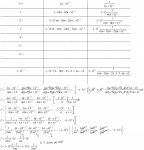
Thanks for the resource! That was something I didn't know. Also, I've solved most of it...but I'm still missing something. And sorry about the image. The table encapsulated in \(\displaystyle wouldn't show up properly.\)
 

Attachments

  • 570_74_2016_tabel.jpg
    570_74_2016_tabel.jpg
    422.2 KB · Views: 9
Thanks for the resource! That was something I didn't know. Also, I've solved most of it...but I'm still missing something. And sorry about the image. The table encapsulated in \(\displaystyle wouldn't show up properly.\)
\(\displaystyle
First carry your table one step further until you have a zero in the middle column (the derivative column). That way there is no integral left over.

Next, as you say, is n odd or is n even. Notice the pattern: When the right hand column (the one with either the + or the - sign) is even [0+, 2+, 4+, 6+, ...] the result is, ignoring the (1)k for some k, 'minus the diagonal multiplication', i.e.
\(\displaystyle -\dfrac{(a-x)^{n-1}}{(a+x)^{n}}, \, -\dfrac{(a-x)^{n-3}}{(a+x)^{n-2}}, \,-\dfrac{(a-x)^{n-5}}{(a+x)^{n-4}}, ...\)
and, of course, a plus sign for the other.

So, if n-1 is even then ...
Or, if n-1 is odd then ...\)
 
First carry your table one step further until you have a zero in the middle column (the derivative column). That way there is no integral left over.

Next, as you say, is n odd or is n even. Notice the pattern: When the right hand column (the one with either the + or the - sign) is even [0+, 2+, 4+, 6+, ...] the result is, ignoring the (1)k for some k, 'minus the diagonal multiplication', i.e.
\(\displaystyle -\dfrac{(a-x)^{n-1}}{(a+x)^{n}}, \, -\dfrac{(a-x)^{n-3}}{(a+x)^{n-2}}, \,-\dfrac{(a-x)^{n-5}}{(a+x)^{n-4}}, ...\)
and, of course, a plus sign for the other.

So, if n-1 is even then ...
Or, if n-1 is odd then ...

There's Calculus, Advanced Calculus, and then there's Demonic Calculus. Guess which one this one turned out to be. Go on. Guess.

\(\displaystyle
\displaystyle \eqalign{
& I = \int_0^a {{{{{(a - x)}^{n - 1}}} \over {{{(a + x)}^{n + 1}}}}dx,a > 0,n \in {N^*}} \cr
& I = \int_0^a {{{\left( {{{a - x} \over {a + x}}} \right)}^{n - 1}} \cdot {1 \over {{{(a + x)}^2}}}dx} \cr
& Notation:{{a - x} \over {a + x}} = y \Rightarrow {{ - a - x - a + x} \over {{{(a + x)}^2}}}dx = dy \Rightarrow {1 \over {{{(a + x)}^2}}}dx = - {{dy} \over {2a}} \cr
& For\;x = a \Rightarrow y = 0 \cr
& For\;x = 0 \Rightarrow y = 1 \cr
& I = \int_1^0 {{y^{n - 1}}{1 \over {2a}}} ( - dy) = {1 \over {2a}}\int_0^1 {{y^{n - 1}}} dy = \left. {{{{y^n}} \over n}} \right|_0^1 = {1 \over {2a}}\left( {{{{1^n}} \over n} - {{{0^n}} \over n}} \right) = {1 \over {2na}} \cr} \)
 
There's Calculus, Advanced Calculus, and then there's Demonic Calculus. Guess which one this one turned out to be. Go on. Guess.

\(\displaystyle
\displaystyle \eqalign{
& I = \int_0^a {{{{{(a - x)}^{n - 1}}} \over {{{(a + x)}^{n + 1}}}}dx,a > 0,n \in {N^*}} \cr
& I = \int_0^a {{{\left( {{{a - x} \over {a + x}}} \right)}^{n - 1}} \cdot {1 \over {{{(a + x)}^2}}}dx} \cr
& Notation:{{a - x} \over {a + x}} = y \Rightarrow {{ - a - x - a + x} \over {{{(a + x)}^2}}}dx = dy \Rightarrow {1 \over {{{(a + x)}^2}}}dx = - {{dy} \over {2a}} \cr
& For\;x = a \Rightarrow y = 0 \cr
& For\;x = 0 \Rightarrow y = 1 \cr
& I = \int_1^0 {{y^{n - 1}}{1 \over {2a}}} ( - dy) = {1 \over {2a}}\int_0^1 {{y^{n - 1}}} dy = \left. {{{{y^n}} \over n}} \right|_0^1 = {1 \over {2a}}\left( {{{{1^n}} \over n} - {{{0^n}} \over n}} \right) = {1 \over {2na}} \cr} \)

It's a bit tricky but not demonic!!

\(\displaystyle \displaystyle{\int sec(x) dx = Log_e[sec(x) + tan(x)]}\) ..... Now that is demonic.....
 
Top