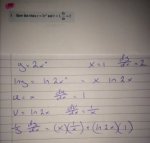
Okay, so the image is small and hard for me to read, but here's what I think it says. Please provide any necessary corrections:
Show that when \(\displaystyle y=2x^x\) and \(\displaystyle x=1\), \(\displaystyle \frac{dy}{dx}=2\)
Then your workings are as follows:
\(\displaystyle ln(y)=ln(2x^x)=x \cdot ln(2x)\)
\(\displaystyle u=x \implies \frac{du}{dx}=1\)
\(\displaystyle v=ln(2x) \implies \frac{dv}{dx}=\frac{1}{x}\)
\(\displaystyle \frac{1}{y} \cdot \frac{dy}{dx}=x \cdot \frac{1}{x} + ln(2x) \cdot 1\)
Assuming I've copied it correctly, everything you've done is valid, and you can reach the solution that way. However, I'd personally recommend a different tactic. Since you're merely taking a derivative, there's no reason to treat it like a differential equation. Instead, I'd try this:
\(\displaystyle \frac{d}{dx}(2x^x)=2 \: \frac{d}{dx}(x^x)=2 \: \frac{d}{dx}(e^{x \: ln(x)})\)
Let \(\displaystyle u=e^{x \: ln(x)}\). Then apply the chain rule:
\(\displaystyle 2 \cdot \frac{d}{dx}(e^{x \: ln(x)})=2 \: \frac{d}{du}(e^u) \: \frac{d}{dx}(x \: ln(x))\)
Continue from here, and see where you get to...