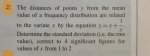
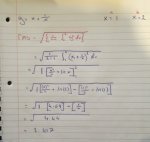
A Anthonyk2013 Junior Member Joined Sep 15, 2013 Messages 132 Oct 10, 2015 #1 Answer in book is 2.198 can see where I have gone wrong. Attachments image.jpg 28 KB · Views: 0 image.jpg 15.3 KB · Views: 0 Last edited by a moderator: Oct 10, 2015
D Deleted member 4993 Guest Oct 10, 2015 #2 Anthonyk2013 said: Answer in book is 2.198 can see where I have gone wrong. Click to expand... The third line is incorrect. (x + 1/x) ^2 = x^2 + 2 + x^(-2) Integrating that you should get: 1/3 * x^3 + 2 * x - 1/x Now apply limits and then take square-root of that number.
Anthonyk2013 said: Answer in book is 2.198 can see where I have gone wrong. Click to expand... The third line is incorrect. (x + 1/x) ^2 = x^2 + 2 + x^(-2) Integrating that you should get: 1/3 * x^3 + 2 * x - 1/x Now apply limits and then take square-root of that number.
A Anthonyk2013 Junior Member Joined Sep 15, 2013 Messages 132 Oct 10, 2015 #3 Subhotosh Khan said: The third line is incorrect. (x + 1/x) ^2 = x^2 + 2 + x^(-2) Integrating that you should get: 1/3 * x^3 + 2 * x - 1/x Now apply limits and then take square-root of that number. Click to expand... Thank you.
Subhotosh Khan said: The third line is incorrect. (x + 1/x) ^2 = x^2 + 2 + x^(-2) Integrating that you should get: 1/3 * x^3 + 2 * x - 1/x Now apply limits and then take square-root of that number. Click to expand... Thank you.