
You are using an out of date browser. It may not display this or other websites correctly.
You should upgrade or use an alternative browser.
You should upgrade or use an alternative browser.
Radius of convergence
- Thread starter rettore84
- Start date
D
Deleted member 4993
Guest
Hello to all,
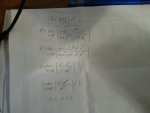
I'm trying to solve the question attached. The answer given is "e" however I'm getting 1. Could someone please help me? Thanks in advance.
I cannot read your problem statement!
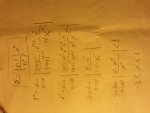
Hello to all,
I'm trying to solve the question attached. The answer given is "e" however I'm getting 1. Could someone please help me? Thanks in advance.
You are all right down to
\(\displaystyle \underset{n \to \infty}{lim}\, \frac{n^n\, x}{(n+1)^n}\)
However, you can not just cross out the 1 on the n+1. Depending on just what you have studied, you should be able to get to
\(\displaystyle \underset{n \to \infty}{lim}\, (\frac{n+1}{n})^n\, =\,\underset{n \to \infty}{lim}\, (1\, +\, \frac{1}{n})^n\, =\, e\)
You are all right down to
[FONT=MathJax_Math]l[/FONT][FONT=MathJax_Math]i[/FONT][FONT=MathJax_Math]m[/FONT][FONT=MathJax_Math]n[/FONT][FONT=MathJax_Main]→[/FONT][FONT=MathJax_Main]∞[/FONT][FONT=MathJax_Math]n[/FONT][FONT=MathJax_Math]n[/FONT][FONT=MathJax_Math]x[/FONT][FONT=MathJax_Main]([/FONT][FONT=MathJax_Math]n[/FONT][FONT=MathJax_Main]+[/FONT][FONT=MathJax_Main]1[/FONT][FONT=MathJax_Main])[/FONT][FONT=MathJax_Math]n[/FONT]
However, you can not just cross out the 1 on the n+1. Depending on just what you have studied, you should be able to get to
[FONT=MathJax_Math]l[/FONT][FONT=MathJax_Math]i[/FONT][FONT=MathJax_Math]m[/FONT][FONT=MathJax_Math]n[/FONT][FONT=MathJax_Main]→[/FONT][FONT=MathJax_Main]∞[/FONT][FONT=MathJax_Main]([/FONT][FONT=MathJax_Math]n[/FONT][FONT=MathJax_Main]+[/FONT][FONT=MathJax_Main]1[/FONT][FONT=MathJax_Math]n[/FONT][FONT=MathJax_Main])[/FONT][FONT=MathJax_Math]n[/FONT][FONT=MathJax_Main]=[/FONT][FONT=MathJax_Math]l[/FONT][FONT=MathJax_Math]i[/FONT][FONT=MathJax_Math]m[/FONT][FONT=MathJax_Math]n[/FONT][FONT=MathJax_Main]→[/FONT][FONT=MathJax_Main]∞[/FONT][FONT=MathJax_Main]([/FONT][FONT=MathJax_Main]1[/FONT][FONT=MathJax_Main]+[/FONT][FONT=MathJax_Main]1[/FONT][FONT=MathJax_Math]n[/FONT][FONT=MathJax_Main])[/FONT][FONT=MathJax_Math]n[/FONT][FONT=MathJax_Main]=[/FONT][FONT=MathJax_Math]e[/FONT]
ok I got it that this [FONT=MathJax_Math]l[/FONT][FONT=MathJax_Math]i[/FONT][FONT=MathJax_Math]m[/FONT][FONT=MathJax_Math]n[/FONT][FONT=MathJax_Main]→[/FONT][FONT=MathJax_Main]∞[/FONT][FONT=MathJax_Math]n[/FONT][FONT=MathJax_Math]n[/FONT][FONT=MathJax_Math]x[/FONT][FONT=MathJax_Main]([/FONT][FONT=MathJax_Math]n[/FONT][FONT=MathJax_Main]+[/FONT][FONT=MathJax_Main]1[/FONT][FONT=MathJax_Main])[/FONT][FONT=MathJax_Math]n[/FONT] can be --> lim (n/n+1)^n and this converges to "1/e", because this is the reciprocal of this lim (n+1/n)^n which is "e".
So the answer should be 1/e?
[FONT=MathJax_Math]l[/FONT][FONT=MathJax_Math]i[/FONT][FONT=MathJax_Math]m[/FONT][FONT=MathJax_Math]n[/FONT][FONT=MathJax_Main]→[/FONT][FONT=MathJax_Main]∞[/FONT][FONT=MathJax_Main]([/FONT][FONT=MathJax_Math]n[/FONT][FONT=MathJax_Main]+[/FONT][FONT=MathJax_Main]1[/FONT][FONT=MathJax_Math]n[/FONT][FONT=MathJax_Main])[/FONT][FONT=MathJax_Math]n[/FONT][FONT=MathJax_Main][/FONT][FONT=MathJax_Math]l[/FONT][FONT=MathJax_Math]i[/FONT][FONT=MathJax_Math]m[/FONT][FONT=MathJax_Math]n[/FONT][FONT=MathJax_Main]→[/FONT][FONT=MathJax_Main]∞[/FONT][FONT=MathJax_Main]([/FONT][FONT=MathJax_Math]n[/FONT][FONT=MathJax_Main]+[/FONT][FONT=MathJax_Main]1[/FONT][FONT=MathJax_Math]n[/FONT][FONT=MathJax_Main])[/FONT][FONT=MathJax_Math]n[/FONT][FONT=MathJax_Math]l[/FONT][FONT=MathJax_Math]i[/FONT][FONT=MathJax_Math]m[/FONT][FONT=MathJax_Math]n[/FONT][FONT=MathJax_Main]→[/FONT][FONT=MathJax_Main]∞[/FONT][FONT=MathJax_Main]([/FONT][FONT=MathJax_Math]n[/FONT][FONT=MathJax_Main]+[/FONT][FONT=MathJax_Main]1[/FONT][FONT=MathJax_Math]n[/FONT][FONT=MathJax_Main])[/FONT][FONT=MathJax_Math]n[/FONT]
You're on the right track. The limit does converge to 1/e, but I don't think that's the answer your book/instructor is looking for. You didn't post the instructions, so I'm just guessing here, but based on the title of your post, the given task was to find the radius of convergence. So, find the values of x where the expression is less than one:
\(\displaystyle \displaystyle \lim _{n\to \infty }\left(\left|\frac{x\cdot n^n}{\left(n+1\right)^n}\right|\right)= \left|x\right|\cdot \lim _{n\to \infty }\left(\left(\frac{n}{n+1}\right)^n\right)=\left|x\right|\cdot \frac{1}{e}\)
\(\displaystyle \left|x\right|\cdot \frac{1}{e}<1\)
You take it from here...
\(\displaystyle \displaystyle \lim _{n\to \infty }\left(\left|\frac{x\cdot n^n}{\left(n+1\right)^n}\right|\right)= \left|x\right|\cdot \lim _{n\to \infty }\left(\left(\frac{n}{n+1}\right)^n\right)=\left|x\right|\cdot \frac{1}{e}\)
\(\displaystyle \left|x\right|\cdot \frac{1}{e}<1\)
You take it from here...
