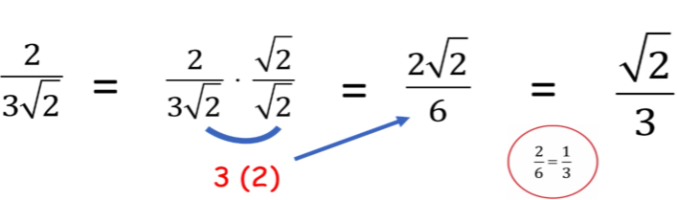
If going through this 52 years ago as a High School Sophomore makes it new, then yes I'm new to it.

Division is, at its core, a multiplication, the multiplication by an inverse element. Inverse elements are noted by [imath] a^{-1}, [/imath] so [imath] 1/2=2^{-1} [/imath] or [imath] 1/3=3^{-1}. [/imath] This translates the equation to
[math] \dfrac{2}{3\sqrt{2}} =2\cdot \left(3\cdot \sqrt{2}\right)^{-1}=2\cdot \left(3^{-1}\cdot \sqrt{2}^{-1}\right)[/math]and we can use the facts that multiplication is commutative, [imath] a\cdot b=b\cdot a, [/imath] and associative, [imath] a\cdot (b\cdot c)=(a\cdot b)\cdot c, [/imath] and we can group the numbers and forget the order
[math] \dfrac{2}{3\sqrt{2}}= 2\cdot \sqrt{2}^{-1}\cdot 3^{-1}=\dfrac{2\sqrt{2}^{-1}}{3}. [/math]
Division is mathematically a multiplication, and this is a quasi division-free notation.
What's left to do is calculating
[math] 2\sqrt{2}^{-1}=\left(\sqrt{2}\cdot \sqrt{2}\right)\cdot \sqrt{2}^{-1}=\sqrt{2}\cdot \left(\sqrt{2}\cdot \sqrt{2}^{-1}\right)=\sqrt{2}\cdot 1=\sqrt{2}. [/math]
This path may look a bit artificial, but it results from only using the basic properties of multiplication:
- There is a [imath] 1, [/imath] i.e. [imath] 1\cdot a=a. [/imath]
- There is an inverse [imath] a^{-1}, [/imath] i.e. [imath] a\cdot a^{-1}=1. [/imath]
- Multiplication is associative, i.e. [imath] a\cdot (b\cdot c)=(a\cdot b)\cdot c. [/imath]
- Multiplication is commutative, i.e. [imath] a\cdot b=b\cdot a. [/imath]
These are mathematically the foundations of multiplication. Note that there is no division, only a multiplication by inverse elements. It has the advantage that we do not have to care about order and placement. It is also the key to those FB posts that write [imath] 2\div 3\cdot \sqrt{2} [/imath] and use the ambiguity caused by missing parentheses to initiate meaningless discussions: does it mean [imath] 2\div 3\cdot \sqrt{2}=2\cdot 3^{-1}\cdot \sqrt{2} [/imath] or [imath] 2\div 3\cdot \sqrt{2}=2\cdot 3^{-1}\cdot \sqrt{2}^{-1} \,[/imath]? Once you accept that division is only a lazy way to write multiplications by inverse elements, the ambiguity and senselessness of such posts become obvious.