Taliaferro
New member
- Joined
- Aug 4, 2014
- Messages
- 12
Hello friends! I need your insight on this problem.
i. Use Rolle's theorem to prove that \(\displaystyle f(x)\, =\, 3x^5\, +\, 10x^3\, +\, 15x\, +\, 2\) has at most one real root.
HINT: If \(\displaystyle f\) has two roots (say \(\displaystyle a\) and \(\displaystyle b\)) then \(\displaystyle f(a)\, =\, f(b)\, =\, 0.\) What does Rolle's theorem say in this situation?
ii. Let \(\displaystyle f\) be continuous on \(\displaystyle [a,\, b]\) and differentiable on \(\displaystyle (a,\, b).\) Show that there exists \(\displaystyle c\, \in\, (a,\, b)\) such that the tangent at \(\displaystyle \left(c,\, f(c)\right)\) is parallel to the secant through \(\displaystyle \left(a,\, f(a)\right)\) and \(\displaystyle \left(b,\, f(b)\right).\) In other words, show that:
. . . . .\(\displaystyle f'(c)\, =\, \dfrac{f(b)\, -\, f(a)}{b\, -\, a}\). . . . .\(\displaystyle (1)\)
Equation \(\displaystyle (1)\) is known as the Mean Value Theorem formula.
HINT: Apply Rolle's theorem on \(\displaystyle [a,\, b]\) to the function
. . . . .\(\displaystyle G(x)\, =\, \left(f(b)\, -\, f(a)\right)(x\, -\, a)\, +\, \left(f(b)\, -\, f(x)\right)(b\, -\, a)\)
Keep in mind that \(\displaystyle a,\, f(a),\, b, \) and \(\displaystyle f(b)\) are constants.
The first part I believe I understand. Rolle's theorem states that a continuous/differentiable function that has equal values at two distinct points must have a point between them where the first derivative is zero. Therefore if the polynomial has 2 or more roots there would be f(a) = 0 = f(b) and there would be a c in (a , b) where f'(c)=0
So the derivative is
. . . . .\(\displaystyle \displaystyle{f'(x)\, =\, 15x^4\, +\, 30x^2\, +\, 15}\)
Since f'(x) is positive, or greater than 0 for all x then there is no f'(c)=0 and there must be at most one real root, am I correct in my justification?
My real question comes from how to tackle the second part of the problem (it was especially the HINT that confused me). I get what the problem is asking me graphically, but for some reason I'm having trouble doing the actual math.
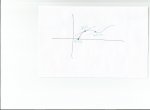
Very crude drawing of how I picture in my mind what the second part of the problem is asking me (see below)
I appreciate any help you can offer!
i. Use Rolle's theorem to prove that \(\displaystyle f(x)\, =\, 3x^5\, +\, 10x^3\, +\, 15x\, +\, 2\) has at most one real root.
HINT: If \(\displaystyle f\) has two roots (say \(\displaystyle a\) and \(\displaystyle b\)) then \(\displaystyle f(a)\, =\, f(b)\, =\, 0.\) What does Rolle's theorem say in this situation?
ii. Let \(\displaystyle f\) be continuous on \(\displaystyle [a,\, b]\) and differentiable on \(\displaystyle (a,\, b).\) Show that there exists \(\displaystyle c\, \in\, (a,\, b)\) such that the tangent at \(\displaystyle \left(c,\, f(c)\right)\) is parallel to the secant through \(\displaystyle \left(a,\, f(a)\right)\) and \(\displaystyle \left(b,\, f(b)\right).\) In other words, show that:
. . . . .\(\displaystyle f'(c)\, =\, \dfrac{f(b)\, -\, f(a)}{b\, -\, a}\). . . . .\(\displaystyle (1)\)
Equation \(\displaystyle (1)\) is known as the Mean Value Theorem formula.
HINT: Apply Rolle's theorem on \(\displaystyle [a,\, b]\) to the function
. . . . .\(\displaystyle G(x)\, =\, \left(f(b)\, -\, f(a)\right)(x\, -\, a)\, +\, \left(f(b)\, -\, f(x)\right)(b\, -\, a)\)
Keep in mind that \(\displaystyle a,\, f(a),\, b, \) and \(\displaystyle f(b)\) are constants.
The first part I believe I understand. Rolle's theorem states that a continuous/differentiable function that has equal values at two distinct points must have a point between them where the first derivative is zero. Therefore if the polynomial has 2 or more roots there would be f(a) = 0 = f(b) and there would be a c in (a , b) where f'(c)=0
So the derivative is
. . . . .\(\displaystyle \displaystyle{f'(x)\, =\, 15x^4\, +\, 30x^2\, +\, 15}\)
Since f'(x) is positive, or greater than 0 for all x then there is no f'(c)=0 and there must be at most one real root, am I correct in my justification?
My real question comes from how to tackle the second part of the problem (it was especially the HINT that confused me). I get what the problem is asking me graphically, but for some reason I'm having trouble doing the actual math.
Very crude drawing of how I picture in my mind what the second part of the problem is asking me (see below)
I appreciate any help you can offer!
Last edited by a moderator: