
jonnburton
Junior Member
- Joined
- Dec 16, 2012
- Messages
- 155
I have been following a worked example of the second moment of area from my book and there are a couple of things which I don't understand.
Find the second moment of area of the plane figure bounded by the curve \(\displaystyle y=x^2+3\), the x-axis and the ordinates at x=1 and x=3, about the y axis.
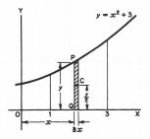
I can follow the working which obtains this result for \(\displaystyle I_y\)without problem. But it then goes on to say: had we been asked to find \(\displaystyle I_x\), we should take second moment of the strip about OX, i.e. \(\displaystyle \frac{y^3}{3}\delta x\) and sum for all strips...
I don't understand where this figure of \(\displaystyle \frac{y^3}{3}\delta x\) comes from...
This is the way I would have tried to find the second moment of area about the x-axis:
Take a horizontal strip parallel to x-axis.
Area of strip = \(\displaystyle x\cdot \delta y\)
Second moment of area = \(\displaystyle ak^2 = x\delta y \cdot y^2\)
We need the area between x=0 and x=3
the corresponding limits in terms of y are y=3 and y=12
So using these limits and integrating the expession to sum all such strips gives:\(\displaystyle \int^{12}_0 xy^2dy\)
Since \(\displaystyle y=x^2+3\), \(\displaystyle x=\sqrt{y-3}\). Integral then can be expressed:
\(\displaystyle \int^{12}_0(y-3)^{\frac{1}{2}}y^2dy\)
\(\displaystyle \int^{12}_0 y^{\frac{3}{2}}-\sqrt3y^2 dy\)
This comes out at \(\displaystyle \left[\frac{2}{5}y^{\frac{5}{2}}-\frac{\sqrt3}{3}y^3\right]^{12}_3\) but having done a quick calculation with this, the result doesn't look right.
Could anyone tell me where my thinking is going wrong?
Find the second moment of area of the plane figure bounded by the curve \(\displaystyle y=x^2+3\), the x-axis and the ordinates at x=1 and x=3, about the y axis.
I can follow the working which obtains this result for \(\displaystyle I_y\)without problem. But it then goes on to say: had we been asked to find \(\displaystyle I_x\), we should take second moment of the strip about OX, i.e. \(\displaystyle \frac{y^3}{3}\delta x\) and sum for all strips...
I don't understand where this figure of \(\displaystyle \frac{y^3}{3}\delta x\) comes from...
This is the way I would have tried to find the second moment of area about the x-axis:
Take a horizontal strip parallel to x-axis.
Area of strip = \(\displaystyle x\cdot \delta y\)
Second moment of area = \(\displaystyle ak^2 = x\delta y \cdot y^2\)
We need the area between x=0 and x=3
the corresponding limits in terms of y are y=3 and y=12
So using these limits and integrating the expession to sum all such strips gives:\(\displaystyle \int^{12}_0 xy^2dy\)
Since \(\displaystyle y=x^2+3\), \(\displaystyle x=\sqrt{y-3}\). Integral then can be expressed:
\(\displaystyle \int^{12}_0(y-3)^{\frac{1}{2}}y^2dy\)
\(\displaystyle \int^{12}_0 y^{\frac{3}{2}}-\sqrt3y^2 dy\)
This comes out at \(\displaystyle \left[\frac{2}{5}y^{\frac{5}{2}}-\frac{\sqrt3}{3}y^3\right]^{12}_3\) but having done a quick calculation with this, the result doesn't look right.
Could anyone tell me where my thinking is going wrong?
Last edited: