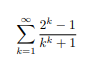
K kddd1232 New member Joined Jun 13, 2019 Messages 1 Jun 13, 2019 #1 This seems like can be done with root or ratio test, but I suck at algebra so I'm stuck finding the limit, any help?Thanks!
This seems like can be done with root or ratio test, but I suck at algebra so I'm stuck finding the limit, any help?Thanks!
LCKurtz Full Member Joined May 3, 2019 Messages 475 Jun 13, 2019 #2 kddd1232 said: View attachment 12592 This seems like can be done with root or ratio test, but I suck at algebra so I'm stuck finding the limit, any help?Thanks! Click to expand... Maybe try comparison? You might start with [MATH]2^k - 1 \le 2^k[/MATH] and [MATH]k^k + 1 \ge k^k[/MATH].
kddd1232 said: View attachment 12592 This seems like can be done with root or ratio test, but I suck at algebra so I'm stuck finding the limit, any help?Thanks! Click to expand... Maybe try comparison? You might start with [MATH]2^k - 1 \le 2^k[/MATH] and [MATH]k^k + 1 \ge k^k[/MATH].
pka Elite Member Joined Jan 29, 2005 Messages 11,978 Jun 13, 2019 #3 kddd1232 said: View attachment 12592 This seems like can be done with root or ratio test, but I suck at algebra so I'm stuck finding the limit, any help?Thanks! Click to expand... Surely you realize that \(\displaystyle \frac{2^k-1}{k^k+1}\le \frac{2^k}{k^k}\), WHY? What can you do with that?
kddd1232 said: View attachment 12592 This seems like can be done with root or ratio test, but I suck at algebra so I'm stuck finding the limit, any help?Thanks! Click to expand... Surely you realize that \(\displaystyle \frac{2^k-1}{k^k+1}\le \frac{2^k}{k^k}\), WHY? What can you do with that?