
setting up rates

Dorian Gray

Junior Member
Joined
Jan 20, 2012
Messages
143
Hello Everyone,

I was wondering if someone could please look at my work for this problem:

Gravel is being dumped from a conveyor belt at a rate of 30 cubic feet/min, and its coarseness is such that it forms a pile in the shape of a cone whose base diameter and height are always equal. How fast is the height of the pile increasing when the pile is 10 ft high?
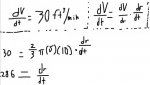
Screen shot 2012-02-24 at 12.24.05 PM.jpg

Thanks,


p.s. My professor only had time two show us 2 examples (and they were not similar to this one), and we only discussed related rates for about 20 minutes. I am NOT asking for anyone to give me a lesson on them, but please try to keep things in the simplest form as possible based on the situation.
 
Last edited:
Hello Everyone,

I was wondering if someone could please look at my work for this problem:

Gravel is being dumped from a conveyor belt at a rate of 30 cubic feet/min, and its coarseness is such that it forms a pile in the shape of a cone whose base diameter and height are always equal. How fast is the height of the pile increasing when the pile is 10 ft high?

View attachment 1749

Thanks,


p.s. My professor only had time two show us 2 examples (and they were not similar to this one), and we only discussed related rates for about 20 minutes. I am NOT asking for anyone to give me a lesson on them, but please try to keep things in the simplest form as possible based on the situation.

Hi Dorian.

Since we are looking or dh/dt, we want to first get our volume of a cone all in terms of h.

\(\displaystyle \displaystyle V=\frac{1}{3}\pi r^2h\)

Now we know that diameter (d) = h. This is the same as 2r = h and thus r = h/2. Plug this into the volume formula and you get:

\(\displaystyle \displaystyle V=\frac{1}{3}\pi(\frac{h}{2})^2h\)

\(\displaystyle \displaystyle V=\frac{1}{3}\pi\frac{h^2}{4}h\)

\(\displaystyle \displaystyle V=\frac{1}{12}\pi h^3\)

Take the derviative with respect to t and get:

\(\displaystyle \displaystyle \frac{dV}{dt}=\frac{1}{4}\pi h^2\frac{dh}{dt}\)

Now we know \(\displaystyle \displaystyle \frac{dV}{dt}=30\) and h = 10 so plug these in and get:

\(\displaystyle \displaystyle 30=\frac{1}{4}\pi 10^2\frac{dh}{dt}\)

\(\displaystyle \displaystyle 120=100\pi \frac{dh}{dt}\)

\(\displaystyle \displaystyle \frac{dh}{dt}=\frac{120}{100\pi}\)

\(\displaystyle \displaystyle \frac{dh}{dt}=\frac{6}{5\pi}\) or roughly 0.382 ft/min
 
wow

Hello SrMichael,


Wow! I see the difference between what you did (correctly) and what I did (incorrectly).

Would you agree that my biggest mistake was plugging in 5 for r? (That seems to be where I got off track).


Your work is truly amazing. Thank you SO much.

p.s. is it difficult to write in that special font?
 
Hello SrMichael,


Wow! I see the difference between what you did (correctly) and what I did (incorrectly).

Would you agree that my biggest mistake was plugging in 5 for r? (That seems to be where I got off track).


Your work is truly amazing. Thank you SO much.

p.s. is it difficult to write in that special font?

Actually, the biggest mistake was not putting the volume formula in terms of the variable what you are finding the rate for. You wanted to know the rate at which the height is changing, so you need the volume formula in terms of h, not r.
 
Last edited:
Top