
S Saldeat New member Joined Jun 18, 2021 Messages 1 Jun 18, 2021 #1 Hello, I'm a first year computer science student and I have a question about sigma. I'm given this series: Now I don't understand something, if I wanna represent how the series looks from 1 to n should it look like this? or this? Thanks in advance
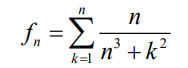


Hello, I'm a first year computer science student and I have a question about sigma. I'm given this series: Now I don't understand something, if I wanna represent how the series looks from 1 to n should it look like this? or this? Thanks in advance
Cubist Senior Member Joined Oct 29, 2019 Messages 1,699 Jun 18, 2021 #2 Your first option (which was missing an equal sign) is correct because k is the variable that increments each term [MATH]f_n=\sum_{k=1}^n\frac{n}{n^3+k^2}=\frac{n}{n^3+1^2}+\frac{n}{n^3+2^2}+\cdots+\frac{n}{n^3+n^2}[/MATH]
Your first option (which was missing an equal sign) is correct because k is the variable that increments each term [MATH]f_n=\sum_{k=1}^n\frac{n}{n^3+k^2}=\frac{n}{n^3+1^2}+\frac{n}{n^3+2^2}+\cdots+\frac{n}{n^3+n^2}[/MATH]
Steven G Elite Member Joined Dec 30, 2014 Messages 14,603 Jun 18, 2021 #3 Why would you think that both n and k changes? n only changes, well when n changes. So what would f2 equal?
Why would you think that both n and k changes? n only changes, well when n changes. So what would f2 equal?