You are using an out of date browser. It may not display this or other websites correctly.
You should upgrade or use an alternative browser.
You should upgrade or use an alternative browser.
SIMPLE Calculus Question
- Thread starter math q
- Start date
View attachment 4570
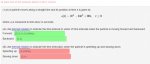
Why on earth is this wrong?
v(t) = 6t^2-48t+90
a(t) = 12t-48
Solving a(t) for 0 should give what I put, right? Any suggestions?
Thanks in advance.
Perhaps the type of bracket "[ or )" is wrong. Just a guess. Anyone on the forum agree? However, your choice of brackets is similar to the velocity problem, which is correct by your online homework.
Last edited:
HallsofIvy
Elite Member
- Joined
- Jan 27, 2012
- Messages
- 7,760
No, you have calculated the derivatives correctly and where the velocity and acceleration are positive and negative but you have misunderstood "speeding up" and "slowing down" The object will be "speeding up" as long as the velocity and acceleration are in the same direction- that is, where they both have the same sign regardless whether that sign is negative or positive. And it will be "slowing down" when they are opposite.
It would be speeding up from \(\displaystyle (4,\infty)\) cause same sign for velocity and acceleration there. On 4 the acceleration and velocity are same sign (negative) Past 4, acceleration and velocity are same sign (positive)
Slowing down on \(\displaystyle [0,3)\) cause different signs for velocity and acceleration.
Slowing down on \(\displaystyle [0,3)\) cause different signs for velocity and acceleration.
Last edited:
 . As you guys mentioned, it was because I falsely interpreted what speeding up and speeding down meant.