
Explain how you can use the graph of y = f'(x) to sketch a possible graph of the original function, y = f(x). You do not need to include a graph of y = f(x).
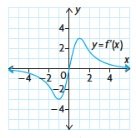
So far I have: Since f'(x) goes from negative to positive at x=0, there must be a minimum on f(x) at x=0. We also know that f(x) is decreasing when x<0, because f'(x) is negative when x<0. f(x) is increasing when x>0, because f'(x) is positive when x>0.
Also, I know there is a cusp of some form at x=-1 and x=1, however I'm not sure what it would look like exactly (other than the slopes even out as you move away from the minimum, decreasing/increasing at a less rapid rate). How would I explain this?
So far I have: Since f'(x) goes from negative to positive at x=0, there must be a minimum on f(x) at x=0. We also know that f(x) is decreasing when x<0, because f'(x) is negative when x<0. f(x) is increasing when x>0, because f'(x) is positive when x>0.
Also, I know there is a cusp of some form at x=-1 and x=1, however I'm not sure what it would look like exactly (other than the slopes even out as you move away from the minimum, decreasing/increasing at a less rapid rate). How would I explain this?
Last edited:

