Solid of revolution of one arc of sin(x) encl. by x-axis, about x-axis

bushdid911

New member
Joined
Aug 13, 2016
Messages
5
Find the volume of one arc of sin(x) enclosed by the x-axis and rotated on the x-axis. I know how to get the answer using the disk method, but I need to use the shell method for this problem. I can't seem to get the right answer.
Disk method- Integral from 0 to pi (dx), with r=sin(x); that gives me pi^2/2. When I use the shell method, I get my limits of integration to be the same, my height to be sin(x), but the radius is what I am struggling finding (assuming we are using dx again)
 
I also attempted to do it in terms of dy, I struggle with the proper length of the cylinder, I get my limits of integration to be 0 to 1, my height to be arcsin(x), but the width seems to be impossible to find
 
Find the volume of one arc of sin(x) enclosed by the x-axis and rotated on the x-axis. I know how to get the answer using the disk method, but I need to use the shell method for this problem. I can't seem to get the right answer.
Disk method- Integral from 0 to pi (dx), with r=sin(x); that gives me pi^2/2. When I use the shell method, I get my limits of integration to be the same, my height to be sin(x), but the radius is what I am struggling finding (assuming we are using dx again)
Starting on page 18 of this document, you will note that, for horizontal axes of rotation (such as, in this case, the x-axis), the integration must necessarily be with respect to y (that is, using "dy" instead of "dx"), due to the nature of the cylindrical shells that you'll be forming.

So, to get started, try restating the function and the limits as x in terms of y. ;)
 
Starting on page 18 of this document, you will note that, for horizontal axes of rotation (such as, in this case, the x-axis), the integration must necessarily be with respect to y (that is, using "dy" instead of "dx"), due to the nature of the cylindrical shells that you'll be forming.

So, to get started, try restating the function and the limits as x in terms of y. ;)
I attempted that, but I can't seem to find the proper length, since this is the same function at two points
 
Starting on page 18 of this document, you will note that, for horizontal axes of rotation (such as, in this case, the x-axis), the integration must necessarily be with respect to y (that is, using "dy" instead of "dx"), due to the nature of the cylindrical shells that you'll be forming.

So, to get started, try restating the function and the limits as x in terms of y. ;)
I can't seem to obtain the length/height as it is the same function at two different points
 
I attempted that, but I can't seem to find the proper length, since this is the same function at two points
I'm sorry, but I don't understand what you mean by "length" (since you're not doing a line integral to find a surface area) or "same function at two points".

Please reply showing your work, so we can see what's going on. Thank you! ;)
 
I'm sorry, but I don't understand what you mean by "length" (since you're not doing a line integral to find a surface area) or "same function at two points".

Please reply showing your work, so we can see what's going on. Thank you! ;)

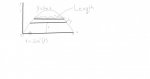
The radius will simply be sin(x)=y, so it will be arcsin(y); my limits of integration will be zero (min) to 1 (max of sine function). Obtaining the last measurement (the horizontal length) is what I find most challenging. It is the last part I need for my integral. I attached a drawing of what I have been doing, that is the length I can't seem to find.
 

Attachments

  • Sine area.jpg
    Sine area.jpg
    8.3 KB · Views: 3
The radius will simply be sin(x)=y, so it will be arcsin(y)...
What is the "it" that will be sin(x) = y? Do you mean that your new function, for working on the y-axis instead of the x-axis, will be x1 = f(y) = arcsin(y)? If so, then, yes, this is correct.

You also know the limits on x. Looking at the graph sideways (on y), you can see that the entire volume will be double the volume of the surface formed from x = 0 to x = pi/2, so you can simplify the process using that information. You'll be working between x1 = f1(y) = arcsin(y) and x2 = f2(y) = pi/2, for the heights of the cylindrical shells.

...my limits of integration will be zero (min) to 1 (max of sine function).
Yes.

Obtaining the last measurement (the horizontal length) is what I find most challenging. It is the last part I need for my integral. I attached a drawing of what I have been doing, that is the length I can't seem to find.
I'm afraid I don't know what you mean by "length" in this context...? You're supposed to be finding expressions for the height and the radius of cylindrical shells.

Again, you need to be working in terms of the y-axis (so the x-axis, and anything parallel to it, would be vertical). Try following the process they showed in your book and in the link I gave you earlier.
 
Top