You are using an out of date browser. It may not display this or other websites correctly.
You should upgrade or use an alternative browser.
You should upgrade or use an alternative browser.
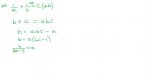
Solve for a: 1/a + 1/b = c
- Thread starter Dale2010
- Start date

mmm4444bot
Super Moderator
- Joined
- Oct 6, 2005
- Messages
- 10,825
Dale2010 said:b + a = abc
but then what?
Get all of the terms that contain the symbol a to one side, with everything else on the other side.
Factor out a.
Divide.
mmm4444bot
Super Moderator
- Joined
- Oct 6, 2005
- Messages
- 10,825
Dale2010 said:scratch that You can edit your posts here; click the [EDIT] button.
a= b/bc-1 This is correct, but it's not properly typed.
Typing b/bc-1 means \(\displaystyle \frac{b}{b} \cdot c - 1\)
When numerators or denominators are algebraic expressions, we need to type grouping symbols around them.
b/(bc - 1) is the proper way.

JuicyBurger
Junior Member
- Joined
- Jan 26, 2010
- Messages
- 96
Re: Solve for a
Another way to solve this...
\(\displaystyle \frac{1}{a}+\frac{1}{b} = c\)
Subtract \(\displaystyle \frac{1}{b}\) from both sides...
\(\displaystyle \frac{1}{a}+\frac{1}{b} - \frac{1}{b} = c - \frac{1}{b}\)
This then equals...
\(\displaystyle \frac{1}{a} = c - \frac{1}{b}\)
Then, multiply both sides by \(\displaystyle a\) and divide both sides by what's on the right...
\(\displaystyle \frac{1}{c - \frac{1}{b}} = a\)
To simplify you can multiply the left by \(\displaystyle \frac{b}{b}\) and you will have the same answer =D
Another way to solve this...
\(\displaystyle \frac{1}{a}+\frac{1}{b} = c\)
Subtract \(\displaystyle \frac{1}{b}\) from both sides...
\(\displaystyle \frac{1}{a}+\frac{1}{b} - \frac{1}{b} = c - \frac{1}{b}\)
This then equals...
\(\displaystyle \frac{1}{a} = c - \frac{1}{b}\)
Then, multiply both sides by \(\displaystyle a\) and divide both sides by what's on the right...
\(\displaystyle \frac{1}{c - \frac{1}{b}} = a\)
To simplify you can multiply the left by \(\displaystyle \frac{b}{b}\) and you will have the same answer =D