Statistics Question

FullestHarp4

New member
Joined
Mar 20, 2021
Messages
7
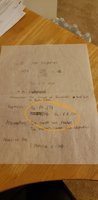
My work is attached.
I have completed most of Part A, however, I'm not sure whether its correct or what the third assumption is. I'm also not sure how to do Part B. Can you help?

The question:

1) It is estimated that 17.4% of all US households own a Roth IRA. The American Association of University Professors (AAUP) believes this figure is different among their members and commissions a study.


a) If 150 out of a random sample of 750 AAUP members own Roth IRA’s, is this sufficient evidence to support the AAUP belief at the α=0.05 level? (You must run a hypothesis test.


b) Based on your results from (a), if an error was made, would it be type I or type II error? Explain the error you chose in the context of the question.
 

Attachments

  • 20210320_010845.jpg
    20210320_010845.jpg
    1.7 MB · Views: 9
  • 20210320_011254.jpg
    20210320_011254.jpg
    1.1 MB · Views: 8
You've submitted this three times under two names, presumably because you didn't realize you had to wait for moderation:
Don't create duplicate threads or posts. There's no reason to do that. You won't get help faster by repeating questions on multiple boards. Also, new members won't see their first five posts appear right away, due to SPAM control (explained here).​

The one error I see is here:
1616285157627.png
Compare that to
The American Association of University Professors (AAUP) believes this figure is different among their members
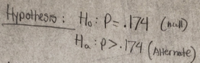
Your alternate hypothesis is that the actual proportion is greater, not just different.

b) Based on your results from (a), if an error was made, would it be type I or type II error? Explain the error you chose in the context of the question.
What is the definition of each type of error?
 
The first one i posted didn't have any of my work posted, so I decided to make a new one. However, posting it a third time was a mistake.

I think its a type 1 error because I rejected the null

Question:
is the .03 number that I got correct?
And
How do I write it so its "different"
 
How do I write it so its "different"
Look in your textbook or other source for how to write the alternative hypothesis. "Different" means "not equal".

This correction will change how you calculate the p-value, so that the 0.03 will change, and your type of error may change. But you're right that if you reject the null, then it is possible that you would have a type I error. The p-value tells you how likely that is.
 
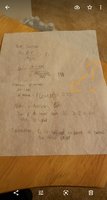
I think I changed the alternate Hypothesis to what it should be, but I don't know how that changes my p value from being .03

Also, I read somewhere that I'm supposed to double whatever I get from the z table (.03)..... so would it really be .06?
 

Attachments

  • Screenshot_20210320-224301_Photos.jpg
    Screenshot_20210320-224301_Photos.jpg
    1.3 MB · Views: 2
  • Screenshot_20210320-224323_Photos.jpg
    Screenshot_20210320-224323_Photos.jpg
    1.2 MB · Views: 1
I think I changed the alternate Hypothesis to what it should be, but I don't know how that changes my p value from being .03

Also, I read somewhere that I'm supposed to double whatever I get from the z table (.03)..... so would it really be .06?
Yes, you've answered your own question. You use the probability that you would observe something further from the claimed value than it is (in either direction), which includes both tails of the curve.
 
So once I change the number from .03 to .06.... I've finished? (That would also mean I wouldn't reject the alternate since its now greater than .05)
 
Yes.
However, I'm not sure whether the members chosen were independent or if the distribution is approximately normal (My last two assumptions)


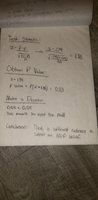
My final (i think) product is attached. Do you see any problems with it?
 

Attachments

  • Screenshot_20210321-194216_Camera.jpg
    Screenshot_20210321-194216_Camera.jpg
    742.9 KB · Views: 13
Yes.
However, I'm not sure whether the members chosen were independent or if the distribution is approximately normal (My last two assumptions)

My final (i think) product is attached. Do you see any problems with it?
Rather than say there is no evidence, I would say that at the α=0.05 level there is insufficient evidence ...

As for assumptions, check your textbook to see if they tell you to assume them, or give an alternative. I'm not an expert on this.
 
Ok. Thanks so much for your help.

Just wondering... what do you get from helping all these people with math problems. Does the website pay you?
 
Top