
You are using an out of date browser. It may not display this or other websites correctly.
You should upgrade or use an alternative browser.
You should upgrade or use an alternative browser.
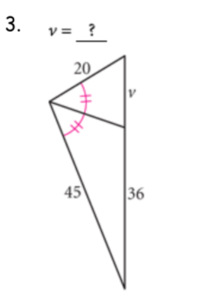
Triangles Similarity: small triangle w/ a=alpha, s1=20, s2=v; medium triangle w/ a=alpha, s=45, s=36; and...
- Thread starter enji
- Start date

Dr.Peterson
Elite Member
- Joined
- Nov 12, 2017
- Messages
- 16,863
Do you know the Angle Bisector Theorem? That directly solves this.
If you can't use that, you can prove it, by thinking about the ratio of the areas of the two triangles.

- Joined
- Nov 24, 2012
- Messages
- 3,021
Do you know the Angle Bisector Theorem? That directly solves this.
If you can't use that, you can prove it, by thinking about the ratio of the areas of the two triangles.
Yes, a friend of mine solved it in seconds using the angle bisector theorem. I guess I am a bit rusty. ?