
You are using an out of date browser. It may not display this or other websites correctly.
You should upgrade or use an alternative browser.
You should upgrade or use an alternative browser.
trig equation solution help
- Thread starter jislonica
- Start date

- Joined
- Apr 12, 2005
- Messages
- 11,325
can someone please assist with
[1+cosx]/sinx] + [sinx]/[1+cosx] = 4
given answer is sinx = 1/2 and i cannot get this... tk u
You were SO CLOSE!
\(\displaystyle \dfrac{2+2\cos(x)}{\sin(x)+\sin(x)\cos(x)} = \dfrac{2\cdot(1+\cos(x))}{\sin(x)\cdot(1+\cos(x))}\) -- Now what?
- Joined
- Apr 12, 2005
- Messages
- 11,325
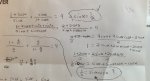
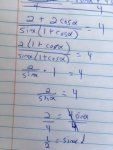
got it... >>> ? >>> View attachment 10904
Why the "?"? Look for errors. If you find none, smile and move on to the next problem. This builds confidence.
Don't be in a rush to EXPAND or to SIMPLIFY or to COMBINE. Sometimes, you want things FACTORED or SEPARATED.
 Experience will help.
\(\displaystyle \dfrac{1 + cos(x)}{sin(x)} + \dfrac{sin(x)}{1 + cos(x)} = 4 \implies\)
\(\displaystyle \left (\dfrac{1 + cos(x)}{sin(x)} * \dfrac{1 + cos(x)}{1 + cos(x)} \right ) + \left ( \dfrac{sin(x)}{1 + cos(x)} * \dfrac{sin(x)}{sin(x)} \right ) = 4 \implies\)
\(\displaystyle \dfrac{1 + 2cos(x) + cos^2(x)}{sin(x) * \{1 + cos(x)\}} + \dfrac{sin^2(x)}{sin(x) * \{1 + cos(x)\}} = 4 \implies\)
\(\displaystyle 4 = \dfrac{1 + 2cos(x) + \{cos^2(x) +sin^2(x)\} }{sin(x) * \{1 + cos(x)\}} = \dfrac{1 + 2cos(x) + 1}{sin(x) * \{1 + cos(x)\}}= \dfrac{2 + 2cos(x)}{sin(x) * \{1 + cos(x)\}} \implies\)
\(\displaystyle 4 = \dfrac{2\{1 + cos(x)\}}{sin(x) * \{1 + cos(x)\}} = \dfrac{2}{sin(x)} \implies\)
\(\displaystyle sin(x) = \dfrac{2}{4} = \dfrac{1}{2}.\)
Well done, but are you supposed to find x?
\(\displaystyle \left (\dfrac{1 + cos(x)}{sin(x)} * \dfrac{1 + cos(x)}{1 + cos(x)} \right ) + \left ( \dfrac{sin(x)}{1 + cos(x)} * \dfrac{sin(x)}{sin(x)} \right ) = 4 \implies\)
\(\displaystyle \dfrac{1 + 2cos(x) + cos^2(x)}{sin(x) * \{1 + cos(x)\}} + \dfrac{sin^2(x)}{sin(x) * \{1 + cos(x)\}} = 4 \implies\)
\(\displaystyle 4 = \dfrac{1 + 2cos(x) + \{cos^2(x) +sin^2(x)\} }{sin(x) * \{1 + cos(x)\}} = \dfrac{1 + 2cos(x) + 1}{sin(x) * \{1 + cos(x)\}}= \dfrac{2 + 2cos(x)}{sin(x) * \{1 + cos(x)\}} \implies\)
\(\displaystyle 4 = \dfrac{2\{1 + cos(x)\}}{sin(x) * \{1 + cos(x)\}} = \dfrac{2}{sin(x)} \implies\)
\(\displaystyle sin(x) = \dfrac{2}{4} = \dfrac{1}{2}.\)
Well done, but are you supposed to find x?