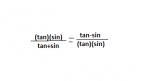
With derivatives
An easy way to demonstrate this identity is the following:
When the first derivative of a function is always equal to 0, the function is constant. In this case, we want to demonstrate that
\(\displaystyle f(x)\, =\, \dfrac{\tan(x)\, \cdot\, \sin(x)}{\tan(x)\, +\, \sin(x)}\, -\, \dfrac{\tan(x)\, -\, \sin(x)}{\tan(x)\, \cdot\, \sin(x)}\)
Is always equal to 0 (i. e. is constant).
Calculatin' its first derivative we obtain that
\(\displaystyle \dfrac{df}{dx}\, =\, 0,\, \forall\, x\, \Rightarrow\, f(x)\, =\, c\)
In order to establish the value of c, we put a value, for instance pi/3:
c = 1/2 - 1/2 = 0
Therefore, the identity is proved.