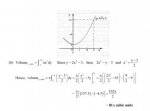
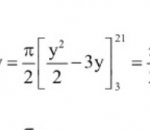
A Anthonyk2013 Junior Member Joined Sep 15, 2013 Messages 132 Dec 15, 2015 #1 Wondering what's going on in this part of the solution. Attachments image.jpg 12.3 KB · Views: 7 image.jpeg 7.1 KB · Views: 8
M MGM New member Joined Dec 11, 2015 Messages 3 Dec 15, 2015 #2 They took the 1/2 outside of the integration, and integrated the expression that was left, i.e (y+3) y+3, when integrated w.r.t dy, becomes (y^2/2)+3y
They took the 1/2 outside of the integration, and integrated the expression that was left, i.e (y+3) y+3, when integrated w.r.t dy, becomes (y^2/2)+3y
A Anthonyk2013 Junior Member Joined Sep 15, 2013 Messages 132 Dec 15, 2015 #3 MGM said: They took the 1/2 outside of the integration, and integrated the expression that was left, i.e (y+3) y+3, when integrated w.r.t dy, becomes (y^2/2)+3y Click to expand... Thanks i I see it now. But what happened to the x^2 on the above line.
MGM said: They took the 1/2 outside of the integration, and integrated the expression that was left, i.e (y+3) y+3, when integrated w.r.t dy, becomes (y^2/2)+3y Click to expand... Thanks i I see it now. But what happened to the x^2 on the above line.
K ksdhart Full Member Joined Aug 1, 2014 Messages 384 Dec 15, 2015 #4 Nothing happened to it. The solution in the image you posted derives a value for x2 in terms of y: \(\displaystyle x^2=\frac{y-3}{2}\) Then take that value and plug it into the integral: \(\displaystyle \displaystyle \text{Volume}_{y-axis}=\int _3^{21}\:\pi \:x^2dy=\pi \int _3^{21}\:\frac{y-3}{2}dy\)
Nothing happened to it. The solution in the image you posted derives a value for x2 in terms of y: \(\displaystyle x^2=\frac{y-3}{2}\) Then take that value and plug it into the integral: \(\displaystyle \displaystyle \text{Volume}_{y-axis}=\int _3^{21}\:\pi \:x^2dy=\pi \int _3^{21}\:\frac{y-3}{2}dy\)