
J JSmith Junior Member Joined Sep 21, 2012 Messages 120 Apr 14, 2013 #1 a) What is the value of ? 4. b) What is the value of ? I have no idea what this notation even means.. help??
a) What is the value of ? 4. b) What is the value of ? I have no idea what this notation even means.. help??
Unknown008 Junior Member Joined Sep 6, 2011 Messages 148 Apr 14, 2013 #2 First one: correct. Second one: Find first \(\displaystyle B \cap D\) Then find the intersection of that set above with set C. And count the number of elements in that resulting set. Does that help?
First one: correct. Second one: Find first \(\displaystyle B \cap D\) Then find the intersection of that set above with set C. And count the number of elements in that resulting set. Does that help?
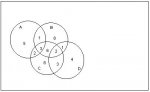
S soroban Elite Member Joined Jan 28, 2005 Messages 5,584 Apr 14, 2013 #3 Hello, JSmith! View attachment 2753 \(\displaystyle \text{(a) What is the value of }n(A \cap B)\,?\;\;4\) . Right! \(\displaystyle \text{(b) What is the value of }n\big[(B \cup D) \cap C\big]\,?\) I have no idea what this notation even means. . You don't? Click to expand... It means: .(Everything in sets B and D) intersected with (set C) We see that it has the regions labeled 3, 6, 2, 3. Therefore: .\(\displaystyle n\big[(B \cup D) \cap C\big] \:=\:3+6+2+3 \:=\:14\)
Hello, JSmith! View attachment 2753 \(\displaystyle \text{(a) What is the value of }n(A \cap B)\,?\;\;4\) . Right! \(\displaystyle \text{(b) What is the value of }n\big[(B \cup D) \cap C\big]\,?\) I have no idea what this notation even means. . You don't? Click to expand... It means: .(Everything in sets B and D) intersected with (set C) We see that it has the regions labeled 3, 6, 2, 3. Therefore: .\(\displaystyle n\big[(B \cup D) \cap C\big] \:=\:3+6+2+3 \:=\:14\)