
Robertmessi
New member
- Joined
- Oct 6, 2020
- Messages
- 4
I have been trying to come up with a way to quantify the data into a concrete decision without having to look at the charts because there is a lot of bias when interpreting charts as well as human error. I have also been looking at the same charts over and over and sometimes the interpretation differs depending on what I feel at that time.
Below is the first chart:
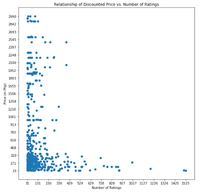
The first chart assumes that each dot represents a listing in an ecommerce website where the y-axis represents the selling price and the x-axis represents the number of people who left a review on the listing.
It can be seen that there is some inversely proportional relationship between selling price and number of ratings, but having sold many products does not mean that you maximize the revenue that you get. Often times if the product is so cheap, the incremental increase to the revenue is also very small so it does not mean selling the most items will yield highest profitability.
Below is the 2nd chart:
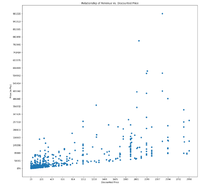
The second chart assumes that each dot represents the same ecommerce listings where the y-axis is the revenue (calculated as [MATH]Selling Price*Number of Ratings[/MATH]) where as the x-axis is the selling price.
It can be seen that despite higher prices yielding lower number of people buying the product, the revenue is still larger for those selling at higher prices. It shows that the price that yields the most revenue is around 2500. However, it is unrealistic to say that the selling price to maximize revenue is always at 2500 due to other unaccounted factors that led people to buy such an expensive product (such as brand, quality, marketing, and etc.); it can also be that the product is an outlier because it is only 1 data point in the entire dataset. So I am hoping to add some probabilistic nature to my model and account all the other data points to kind of muffle the effects of the unaccounted factors mentioned earlier. So the question I want the model to answer is: What selling price should I set for my product to likely maximize my revenue?
I was thinking about regression analysis, however, I code my data using python to return automated analysis and I was hoping to have an analysis that is very robust and can work for all the product data that I feed into the program. In this case, it may be possible to use linear regression as the data kind of shows that increasing the selling price will increase the revenue. However, it may not always be the case. My knowledge in statistics is not sufficient to be know which model I should look for.
There are only 1 method that comes into mind to achieve my goal which is operations research and maximize the objective function, but I do not know if it is achievable or practical to use correctly in my case and hard code it in my script. Any leads would be appreciated.
Below is the first chart:
The first chart assumes that each dot represents a listing in an ecommerce website where the y-axis represents the selling price and the x-axis represents the number of people who left a review on the listing.
It can be seen that there is some inversely proportional relationship between selling price and number of ratings, but having sold many products does not mean that you maximize the revenue that you get. Often times if the product is so cheap, the incremental increase to the revenue is also very small so it does not mean selling the most items will yield highest profitability.
Below is the 2nd chart:
The second chart assumes that each dot represents the same ecommerce listings where the y-axis is the revenue (calculated as [MATH]Selling Price*Number of Ratings[/MATH]) where as the x-axis is the selling price.
It can be seen that despite higher prices yielding lower number of people buying the product, the revenue is still larger for those selling at higher prices. It shows that the price that yields the most revenue is around 2500. However, it is unrealistic to say that the selling price to maximize revenue is always at 2500 due to other unaccounted factors that led people to buy such an expensive product (such as brand, quality, marketing, and etc.); it can also be that the product is an outlier because it is only 1 data point in the entire dataset. So I am hoping to add some probabilistic nature to my model and account all the other data points to kind of muffle the effects of the unaccounted factors mentioned earlier. So the question I want the model to answer is: What selling price should I set for my product to likely maximize my revenue?
I was thinking about regression analysis, however, I code my data using python to return automated analysis and I was hoping to have an analysis that is very robust and can work for all the product data that I feed into the program. In this case, it may be possible to use linear regression as the data kind of shows that increasing the selling price will increase the revenue. However, it may not always be the case. My knowledge in statistics is not sufficient to be know which model I should look for.
There are only 1 method that comes into mind to achieve my goal which is operations research and maximize the objective function, but I do not know if it is achievable or practical to use correctly in my case and hard code it in my script. Any leads would be appreciated.
Last edited: