
What is true about this function?

CalcAB

New member
Joined
Jul 31, 2016
Messages
1
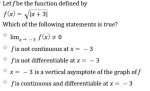
\(\displaystyle \mbox{Let }\, f\, \mbox{ be the func}\mbox{tion defined by }\, f(x)\, =\, \sqrt{\strut |x\, +\, 3|\,}\)

\(\displaystyle \mbox{Which of the following statements is true?}\)

. . .\(\displaystyle \displaystyle \lim_{x\, \rightarrow\, -3}\, f(x)\, \neq\, 0\)

. . .\(\displaystyle f\, \mbox{ is not continuous at }\, x\, =\, -3\)

. . .\(\displaystyle f\, \mbox{ is not differentiable at }\, x\, =\, -3\)

. . .\(\displaystyle x\, =\, -3\, \mbox{ is a vertical asymptote of the graph of }\, f\)

. . .\(\displaystyle f\, \mbox{ is continuous and differentiable at }\, x\, =\, -3\)

Please give an explanation! thanks
 

Attachments
  • pro.jpg
    pro.jpg
    24.7 KB · Views: 11
Last edited by a moderator:
Well, you're given a multiple choice question with five answers. My strategy would be to go through, one by one, and see if any of the five answers are correct. For instance, given the original function f(x), what is the limit of f(x) as x approaches -3? Is it 0? What, then, can you conclude about whether the first option is the correct answer? Is f continuous at the point x = -3? What does that tell you about whether the second option is the correct answer? Proceed similarly for the other three options. If you're still stuck after doing this, that's okay, but you have to show your work in order for us to help you. As you read in the Read Before Posting thread, we do not do student's homework for them.
 
Please give an explanation!
They already gave you loads of "explanations" in your class and in your textbook, so us "explaining" (giving you the answer) on one more example obviously isn't going to make a difference. Now is the time for you to start working.

\(\displaystyle \mbox{Let }\, f\, \mbox{ be the func}\mbox{tion defined by }\, f(x)\, =\, \sqrt{\strut |x\, +\, 3|\,}\)
This is an algebraic function. You've worked with this back in algebra.

\(\displaystyle \mbox{Which of the following statements is true?}\)

. . .\(\displaystyle x\, =\, -3\, \mbox{ is a vertical asymptote of the graph of }\, f\)
This is a question that you can answer by doing the graph (here) and simply looking. What do you see?

. . .\(\displaystyle f\, \mbox{ is not continuous at }\, x\, =\, -3\)
Look at the graph. Is the line continuous (connected)?

. . .\(\displaystyle \displaystyle \lim_{x\, \rightarrow\, -3}\, f(x)\, \neq\, 0\)
Look at the graph. What value does the function take at x = -3? So does the limit exist, and is it the listed value?

. . .\(\displaystyle f\, \mbox{ is not differentiable at }\, x\, =\, -3\)
To be "differentiable", what needs to be true of the slope of the graph -- from both directions -- as the graph approaches the limit point? Does this graph comply?

. . .\(\displaystyle f\, \mbox{ is continuous and differentiable at }\, x\, =\, -3\)
Review the previous answers. How does this mesh?

If you get stuck, please reply with a clear listing of your thoughts and your efforts, so we can see where you're getting stuck. Thank you! ;)
 
Top