
You are using an out of date browser. It may not display this or other websites correctly.
You should upgrade or use an alternative browser.
You should upgrade or use an alternative browser.
Where functions meet
- Thread starter jess5085
- Start date

D
Deleted member 4993
Guest
What are your thoughts?Hello,
I'm not sure how to attempt this question.
Any help would be appreciated.
Thanks in advance!View attachment 4904
If you are stuck at the beginning tell us and we'll start with the definitions.
Please share your work with us ... even if you know it is wrong
You need to read the rules of this forum. Please read the post titled "Read before Posting" at the following URL:
http://www.freemathhelp.com/forum/th...Before-Posting
Hint:
Find the points where y = x+c intersects the curve in terms of 'c'.
Now check for what value of 'c', those points will be in complex domain.

ClaireWu
New member
- Joined
- Jan 26, 2015
- Messages
- 15
Hello,
I'm not sure how to attempt this question.
Any help would be appreciated.
Thanks in advance!View attachment 4904
For the line not to meet the parabola, the discriminant b^2-4ac' < 0 for the quadratic equation 2x^2-3x-7=x+c,
rearranging, we have 2x^2-4x-7-c=0 and find values of a,b and c' where a=2,b=-4 and c'=-7-c and solve the discriminant inequality
for range of c
Last edited:
For the line not to meet the parabola, the discriminant b^2-4ac' < 0 for the quadratic equation 2x^2-3x-7=x+c,
rearranging, we have 2x^2-4x-7-c=0 and find values of a,b and c' where a=2,b=-4 and c'=-7-c and solve the discriminant inequality
for range of c
Thanks for your help!
I substituted the values in
(-4)^2 - 4(2)(-7-c)
=16+56+c
=72 +c
72+c < 0
c<-72
But the answer is C is <-9?
D
Deleted member 4993
Guest
Thanks for your help!
I substituted the values in
(-4)^2 - 4(2)(-7-c)
=16+56+c
=72 +c
72+c < 0
c<-72
But the answer is C is <-9?
small mistake
(-4)^2 - 4(2)(-7-c)
=16+56+8c
=72 +c
72+8c < 0 → c < -9
But ..
It seems to me that this problem is written incorrectly and thereby clouds the logic needed to solve the problem. It seems to me the problem should be written:
\begin{array}{l}
(eq1)\,\,\,\,\,{y_1} = 2{x^2} - 3x - 7\\
(eq2)\,\,\,\,\,{y_2} = x + c
\end{array}
What we are attempting to find is the value for c which places the line in contact with the parabola at a single point. All values of c less than that value will place the line below the parabola.
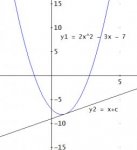
Eqs 1 and 2 deliver a distinct value for y1 and y2 for each value of x, what we want is:
\[(eq3)\,\,\,\,\,{y_1} - {y_2} = {\rm{ }}0\]
so that equations 1 and 2 deliver the same value of y for a particular value of x and c.
\begin{array}{l}
(eq4)\,\,\,\,\,\left( {2{x^2} - 3x - 7} \right) - \left( {x + c} \right) = 0\\
(eq5)\,\,\,\,\,2{x^2} - 4x - 7 + c = 0\\
\end{array}
Now we have two unknowns but seemingly only one condition. BUT …we do have a second condition, namely that the quadratic equation must have a single solution (intersect the parabola at one point only), and this can only occur if it's discriminate is equal to zero, i.e.
\begin{array}{l}
(eq6)\,\,\,\,\,{( - 4)^2} - 4(2)( - 7 + c) = 0\,\,\,\,\,\,\,\,\,\, = > \\
(eq7)\,\,\,\,\,c = - 9
\end{array}
From the figure we see that c must be less than -9 to prevent the line y2 from intersecting with the parabola.
Hello,
I'm not sure how to attempt this question.
Any help would be appreciated.
Thanks in advance!View attachment 4904
It seems to me that this problem is written incorrectly and thereby clouds the logic needed to solve the problem. It seems to me the problem should be written:
\begin{array}{l}
(eq1)\,\,\,\,\,{y_1} = 2{x^2} - 3x - 7\\
(eq2)\,\,\,\,\,{y_2} = x + c
\end{array}
What we are attempting to find is the value for c which places the line in contact with the parabola at a single point. All values of c less than that value will place the line below the parabola.
Eqs 1 and 2 deliver a distinct value for y1 and y2 for each value of x, what we want is:
\[(eq3)\,\,\,\,\,{y_1} - {y_2} = {\rm{ }}0\]
so that equations 1 and 2 deliver the same value of y for a particular value of x and c.
\begin{array}{l}
(eq4)\,\,\,\,\,\left( {2{x^2} - 3x - 7} \right) - \left( {x + c} \right) = 0\\
(eq5)\,\,\,\,\,2{x^2} - 4x - 7 + c = 0\\
\end{array}
Now we have two unknowns but seemingly only one condition. BUT …we do have a second condition, namely that the quadratic equation must have a single solution (intersect the parabola at one point only), and this can only occur if it's discriminate is equal to zero, i.e.
\begin{array}{l}
(eq6)\,\,\,\,\,{( - 4)^2} - 4(2)( - 7 + c) = 0\,\,\,\,\,\,\,\,\,\, = > \\
(eq7)\,\,\,\,\,c = - 9
\end{array}
From the figure we see that c must be less than -9 to prevent the line y2 from intersecting with the parabola.