
Ok the first problem is:
The output Q of an economic system subject to two inputs, such as labor L and capital K, s often modeled by the Cobb-Douglas production function Q(L;K) = cLaKb, where a; b and c are positive real numbers. When a+b = 1, the case is called constant returns to scale. Suppose
a = 1
3 , b = 2
3 and c = 40.
A) If L is held constant at L = 10, write the function that gives the dependence of Q on K.
B) If K is held constant at K = 15, write the function that gives the dependence of Q on L
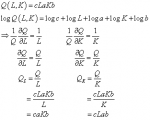
\(\displaystyle Q(L,\, K)\, =\, cLaKb\)
\(\displaystyle \log Q(L,\,K)\, =\, \log c\, +\, \log L\, +\, \log a\, +\, \log K\, +\, \log b\)
\(\displaystyle \Rightarrow\, \dfrac{1}{Q} \dfrac{\partial Q}{\partial L}\, =\, \dfrac{1}{L}\). . . . .\(\displaystyle \dfrac{1}{Q} \dfrac{\partial Q}{\partial K}\, =\, \dfrac{1}{K}\)
. . . . .\(\displaystyle \dfrac{\partial Q}{\partial L}\, =\, \dfrac{Q}{L}\). . . . . ..\(\displaystyle \dfrac{\partial Q}{\partial K}\, =\, \dfrac{Q}{K}\)
. . . . ..\(\displaystyle Q_L\, =\, \dfrac{Q}{L}\). . . . . . .\(\displaystyle Q_K\, =\, \dfrac{Q}{K}\)
. . . . . . . .\(\displaystyle =\, \dfrac{cLaKb}{L}\). . . . . . .\(\displaystyle =\, \dfrac{cLaKb}{K}\)
. . . . . . . .\(\displaystyle =\, caKb\). . . . . . .. .\(\displaystyle =\, cLab\)
Does this look ok
Next I have this problem:
\(\displaystyle \mbox{11. Find the absolute maximum and minimum values of}\)
\(\displaystyle \mbox{the func}\mbox{tion }\, f(x,\, y)\, =\, (x\, -\, 1)^2\, +\, (y\, +\, 1)^2,\, \mbox{ over}\)
\(\displaystyle \mbox{the region }\, R\, =\, \left\{(x,\, y)\, :\, x^2\, +\, y^2\, \leq\, 4\right\}\)
I'm pretty sure you have to use Lagrange multipliers on this one I know you first need to take partial derivatives of the function then set up the scalar equations involving lamba, I know that much but I'm stuck there.
The third problem I have is this:
\(\displaystyle \mbox{14. Eval}\mbox{uate the inte}\mbox{gral:}\)
\(\displaystyle \displaystyle{\iint\limits_R}\, (y^2\, +\, xy\, -\, 2x^2)\, dA\)
\(\displaystyle \mbox{where }\, R\, \mbox{ is the region bounded by the lines }\, y\, =\, x,\)
\(\displaystyle y\, =\, x\, -\, 3,\, y\, =\, -2x\, +\, 3,\, y\, =\, -2x\, -\, 3\)
For this problem I graphed it out and you can see that there are two sets of parallel lines and the region is rectangular so I think you can use a change of variable. I tried v=y and u=2x+y but it didn't work.
The output Q of an economic system subject to two inputs, such as labor L and capital K, s often modeled by the Cobb-Douglas production function Q(L;K) = cLaKb, where a; b and c are positive real numbers. When a+b = 1, the case is called constant returns to scale. Suppose
a = 1
3 , b = 2
3 and c = 40.
A) If L is held constant at L = 10, write the function that gives the dependence of Q on K.
B) If K is held constant at K = 15, write the function that gives the dependence of Q on L
\(\displaystyle Q(L,\, K)\, =\, cLaKb\)
\(\displaystyle \log Q(L,\,K)\, =\, \log c\, +\, \log L\, +\, \log a\, +\, \log K\, +\, \log b\)
\(\displaystyle \Rightarrow\, \dfrac{1}{Q} \dfrac{\partial Q}{\partial L}\, =\, \dfrac{1}{L}\). . . . .\(\displaystyle \dfrac{1}{Q} \dfrac{\partial Q}{\partial K}\, =\, \dfrac{1}{K}\)
. . . . .\(\displaystyle \dfrac{\partial Q}{\partial L}\, =\, \dfrac{Q}{L}\). . . . . ..\(\displaystyle \dfrac{\partial Q}{\partial K}\, =\, \dfrac{Q}{K}\)
. . . . ..\(\displaystyle Q_L\, =\, \dfrac{Q}{L}\). . . . . . .\(\displaystyle Q_K\, =\, \dfrac{Q}{K}\)
. . . . . . . .\(\displaystyle =\, \dfrac{cLaKb}{L}\). . . . . . .\(\displaystyle =\, \dfrac{cLaKb}{K}\)
. . . . . . . .\(\displaystyle =\, caKb\). . . . . . .. .\(\displaystyle =\, cLab\)
Does this look ok
Next I have this problem:
\(\displaystyle \mbox{11. Find the absolute maximum and minimum values of}\)
\(\displaystyle \mbox{the func}\mbox{tion }\, f(x,\, y)\, =\, (x\, -\, 1)^2\, +\, (y\, +\, 1)^2,\, \mbox{ over}\)
\(\displaystyle \mbox{the region }\, R\, =\, \left\{(x,\, y)\, :\, x^2\, +\, y^2\, \leq\, 4\right\}\)
I'm pretty sure you have to use Lagrange multipliers on this one I know you first need to take partial derivatives of the function then set up the scalar equations involving lamba, I know that much but I'm stuck there.
The third problem I have is this:
\(\displaystyle \mbox{14. Eval}\mbox{uate the inte}\mbox{gral:}\)
\(\displaystyle \displaystyle{\iint\limits_R}\, (y^2\, +\, xy\, -\, 2x^2)\, dA\)
\(\displaystyle \mbox{where }\, R\, \mbox{ is the region bounded by the lines }\, y\, =\, x,\)
\(\displaystyle y\, =\, x\, -\, 3,\, y\, =\, -2x\, +\, 3,\, y\, =\, -2x\, -\, 3\)
For this problem I graphed it out and you can see that there are two sets of parallel lines and the region is rectangular so I think you can use a change of variable. I tried v=y and u=2x+y but it didn't work.
Attachments


Last edited by a moderator: