Related Rate Problem

Jason76

Senior Member
Joined
Oct 19, 2012
Messages
1,180
A 6 cm ladder is leaning against the side of a building. The foot of the ladder is pulled away from the house at a rate of \(\displaystyle 0.5 m/sec\) Determine how fast the top of the ladder is descending when the foot of the ladder is 4 meters from the house.
Well we are given one rate \(\displaystyle 0.5 m/sec\) , but we have to find the other. But how do we go about setting this up? :confused:
 
A 6 cm ladder is leaning against the side of a building. The foot of the ladder is pulled away from the house at a rate of 0.5m/sec Determine how fast the top of the ladder is descending when the foot of the ladder is 4 meters from the house.
Well we are given one rate \(\displaystyle 0.5 m/sec\) , but we have to find the other. But how do we go about setting this up? :confused:
Draw the right triangle, representing the side view of the wall (the y-axis), the ground (the x-axis), and the ladder (a slanty line, being the hypotenuse, labelled as "6"). Note: The length should probably be "6 m", as "centimeters" seems a bit short.

Plug the x, y, and hypotenuse into the Pythagorean Theorem, and differentiate with respect to time t. You are given the value for x and for the hypotenuse, from which you can determine the value of y. Obviously, the ladder's length is not changing with respect to time. So plug in all the values you have, and solve for dy/dt. ;)
 
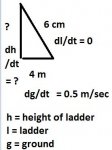
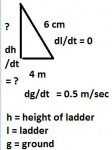
Drawing of the right triangle representing a ladder leaning against a building:

related-rate-drawing.jpg
 
Note: The length should probably be "6 m", as "centimeters" seems a bit short....Plug the x, y, and hypotenuse into the Pythagorean Theorem....
Drawing of the right triangle representing a ladder leaning against a building:

View attachment 3495
:shock:

Did you confirm with your instructor that the ladder is indeed less than two and a half inches? Do you not know what the Pythagorean Theorem is? Or can you not see my original reply, and that's why your new post seems to ignore the step-by-step instructions provided to you?
 
You understand, do you not, that the hypotenuse of a right triangle is always longer than either of the legs? If "the foot of the ladder is 4 meters from the house" then the length of the ladder can't be "6 cm"! I presume you mean the ladder is 6 meters long, not 6 cm.

If we call the distance from the wall to the base of the latter x(t) (t is time- x is a function of t as the ladder slides down the wall) and the height of the ladder on the wall y(t), then, by the Pythagorean Theorem, \(\displaystyle x^2+ y^2= 36\).

Now differentiate both sides with respect to t. By the chain rule, \(\displaystyle 2x \frac{dx}{dt}+ 2y\frac{dy}{dt}= 0\). You are told that x= 4m and can calculate y at that moment. You are also told that dx/dt= 0.5 m/sec. So you know three of the four values in that equation and can solve for the fourth, dy/dt.
 
A 6 cm ladder is leaning against the side of a building. The foot of the ladder is pulled away from the house at a rate of \(\displaystyle 0.5 m/sec\) Determine how fast the top of the ladder is descending when the foot of the ladder is 4 meters from the house.

related-rate-drawing.jpg

\(\displaystyle h^{2} + (4)^{2} = 6^{2}\)

\(\displaystyle h^{2} = 20\)

\(\displaystyle h = \sqrt{20}\)

Sides of the triangle

\(\displaystyle h = \sqrt{20}\)

\(\displaystyle g = 4\)

\(\displaystyle l = 6\)

Now doing a derivative

\(\displaystyle \dfrac{d}{dx}(h^{2} + g^{2} = l^{2})\)

\(\displaystyle \rightarrow 2h + 2g = 2l\)

\(\displaystyle 2(\sqrt{20} (\dfrac{dh}{dt}) + 2(4) (\dfrac{dg}{dt}) = 2(6)(\dfrac{dl}{dt})\)

\(\displaystyle 2(\sqrt{20} (\dfrac{dh}{dt}) + 2(4) (0.5 m/sec) = 2(6)(0)\)

\(\displaystyle 2(\sqrt{20} (\dfrac{dh}{dt}) + 2(4) (0.5 m/sec) = 0\)

\(\displaystyle 2(\sqrt{20} (\dfrac{dh}{dt}) + (4) = 0\)

\(\displaystyle 2(\sqrt{20} (\dfrac{dh}{dt}) = -4\)

\(\displaystyle (\dfrac{dh}{dt}) = \dfrac{-4}{2(\sqrt{20}}\)

\(\displaystyle (\dfrac{dh}{dt}) = \dfrac{-2}{(\sqrt{20}}\) :confused:
 
Last edited:
Top