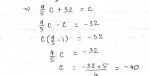
L liz New member Joined Mar 26, 2014 Messages 1 Mar 26, 2014 #1 Hi, I am just wondering why 9/5C - C = -32 becomes C(9/5-1) = -32 in the problem below? What is the rule that makes this so?
Hi, I am just wondering why 9/5C - C = -32 becomes C(9/5-1) = -32 in the problem below? What is the rule that makes this so?
D Deleted member 4993 Guest Mar 26, 2014 #2 liz said: Hi, I am just wondering why 9/5C - C = -32 becomes C(9/5-1) = -32 in the problem below? What is the rule that makes this so? View attachment 3964 Click to expand... Do you understand that: a*(x + y) = a*x + a*y → this is called distributive property of multiplication. The operation you refer to is in the "reverse direction" [ a*x + a*y = a * (x + y)]. It is also sometimes referred to as factorization (in your problem - recognizing common factor "c" and factoring it out).
liz said: Hi, I am just wondering why 9/5C - C = -32 becomes C(9/5-1) = -32 in the problem below? What is the rule that makes this so? View attachment 3964 Click to expand... Do you understand that: a*(x + y) = a*x + a*y → this is called distributive property of multiplication. The operation you refer to is in the "reverse direction" [ a*x + a*y = a * (x + y)]. It is also sometimes referred to as factorization (in your problem - recognizing common factor "c" and factoring it out).