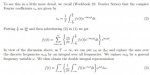
Hi, I was wondering if anyone could explain to me step-by-step, the derivation of the fourier transform. After searching online for the past few days, I couldn't find anything that was clear enough so I came here for some help!
Here is the original fourier series
\(\displaystyle f(x)\, =\, a_0\, +\, \displaystyle{\sum_{n\,=\,1}^{\infty}}\, \left(a_n\, \cos(\omega nx)\, +\, b_n\, \sin(\omega nx)\right)\)
or, expressed in a complex exponential form
\(\displaystyle =\, \displaystyle{\sum_{n\,=\,-\infty}^{\infty}}\, c_n\, e^{i \omega nx}\)
And here's the fourier transform and inverse fourier transform respectively,
\(\displaystyle F\left(\xi\right)\, =\, \displaystyle{\int_{-\infty}^{\infty}}\, f(x)\, e^{-i \omega x}\, dx\)
\(\displaystyle f(x)\, =\, \displaystyle{\int_{-\infty}^{\infty}}\, F\left(\xi\right)\, e^{i \omega x}\, d\xi\)
thanks in advance!
Here is the original fourier series
\(\displaystyle f(x)\, =\, a_0\, +\, \displaystyle{\sum_{n\,=\,1}^{\infty}}\, \left(a_n\, \cos(\omega nx)\, +\, b_n\, \sin(\omega nx)\right)\)
or, expressed in a complex exponential form
\(\displaystyle =\, \displaystyle{\sum_{n\,=\,-\infty}^{\infty}}\, c_n\, e^{i \omega nx}\)
And here's the fourier transform and inverse fourier transform respectively,
\(\displaystyle F\left(\xi\right)\, =\, \displaystyle{\int_{-\infty}^{\infty}}\, f(x)\, e^{-i \omega x}\, dx\)
\(\displaystyle f(x)\, =\, \displaystyle{\int_{-\infty}^{\infty}}\, F\left(\xi\right)\, e^{i \omega x}\, d\xi\)
thanks in advance!
Last edited by a moderator: