
Integration of a Semi Circle

rinachez

New member
Joined
Feb 1, 2015
Messages
1
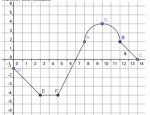
I am trying to find the area of the semi circle using integration given this velocity [ f'(x) ] graph
Screen Shot 2015-02-01 at 1.18.20 AM.jpg

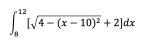
I figured out the equation of the circle but I don't know how to integrate it. Would trig substitution work for this problem since it uses coord points or am I just approaching it incorrectly?
I know how to do the geometry method. I really want to know the calculus method. thank you
Screen Shot 2015-02-01 at 1.22.45 AM.png
 

Attachments

  • Screen Shot 2015-02-01 at 1.17.44 AM.png
    Screen Shot 2015-02-01 at 1.17.44 AM.png
    15.9 KB · Views: 2
I am trying to find the area of the semi circle using integration given this velocity [ f'(x) ] graph

View attachment 4906

I figured out the equation of the circle but I don't know how to integrate it. Would trig substitution work for this problem since it uses coord points or am I just approaching it incorrectly?
I know how to do the geometry method. I really want to know the calculus method. thank you
View attachment 4907
You say you want to find the area of the semi-circle. With that "+ 2", you are finding the area below the semi-circle and the above the x-axis. That is, that will give you the area of the semi-circle plus the area of the rectangle it is "sitting on". I presume you know that the area of a circle of radius 2 is \(\displaystyle 4\pi\) so the area of the semi-circle is \(\displaystyle 2\pi\). The area of the "2 by 4" rectangle below it is 2(4)= 8. Use that to check your integration.

Yes, to do that integral, you should use a trig substitution. If you let \(\displaystyle x= 2 sin(t)+ 10\), then \(\displaystyle x- 10= 2 sin(t)\) so that \(\displaystyle 4- (x- 10)^2= 4- 4sin^2(t)= 4(1- sin^2(t))= 4cos^2(t)\).
Of course, with \(\displaystyle x- 10= 2 sin(t)\), \(\displaystyle dx= 2 cos(t) dt\). When x= 8, 8- 10= -2= 2 sin(t) so sin(t)= -1, \(\displaystyle t= -\pi\). When x= 12, 12- 10= 2= 2 sin(t), \(\displaystyle t= \pi\). The integral becomes \(\displaystyle 8 \int_{-\pi}^{\pi} cos^3(t) dt\). That can be done by writing the integrand as \(\displaystyle cos^2(t)(cos(t)dt)= (1- sin^2(t)(cos(t)dt)\) and making the second substitution \(\displaystyle u= sin(t)\).

The integral \(\displaystyle \int_8^12 2dx= \left[2x\right]_8^{12}= 2(12)- 2(8)= 24- 16= 8\), the area of the 2 by 4 rectangle the semi-circle is sitting on.
 
You say you want to find the area of the semi-circle. With that "+ 2", you are finding the area below the semi-circle and the above the x-axis. That is, that will give you the area of the semi-circle plus the area of the rectangle it is "sitting on". I presume you know that the area of a circle of radius 2 is \(\displaystyle 4\pi\) so the area of the semi-circle is \(\displaystyle 2\pi\). The area of the "2 by 4" rectangle below it is 2(4)= 8. Use that to check your integration.

Yes, to do that integral, you should use a trig substitution. If you let \(\displaystyle x= 2 sin(t)+ 10\), then \(\displaystyle x- 10= 2 sin(t)\) so that \(\displaystyle 4- (x- 10)^2= 4- 4sin^2(t)= 4(1- sin^2(t))= 4cos^2(t)\).
Of course, with \(\displaystyle x- 10= 2 sin(t)\), \(\displaystyle dx= 2 cos(t) dt\). When x= 8, 8- 10= -2= 2 sin(t) so sin(t)= -1, \(\displaystyle t= -\pi\). When x= 12, 12- 10= 2= 2 sin(t), \(\displaystyle t= \pi\). The integral becomes \(\displaystyle 8 \int_{-\pi}^{\pi} cos^3(t) dt\).
Ishuda has pointed out a typo- I meant \(\displaystyle cos^2(t)\).

That can be done by writing the integrand as \(\displaystyle cos^2(t)(cos(t)dt)= (1- sin^2(t)(cos(t)dt)\) and making the second substitution \(\displaystyle u= sin(t)\).

The integral \(\displaystyle \int_8^12 2dx= \left[2x\right]_8^{12}= 2(12)- 2(8)= 24- 16= 8\), the area of the 2 by 4 rectangle the semi-circle is sitting on.
 
Top