
Function Transfomation

qwerty1904

New member
Joined
Feb 13, 2015
Messages
3
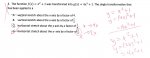
I don't know if this is posted in the right category but as you can see in the image I got that question wrong. I chose C because the coefficient was attached to the X value making this a horizontal stretch. I chose 1/4 because 1/4 is the opposite of 4. However, the correct answer was D and I asked the teacher to explain why (the red pen marks) but I still don't understand how 4 could possibly turn into 1/2.
f(x)=x^2 +1.jpg
 
I don't know if this is posted in the right category but as you can see in the image I got that question wrong. I chose C because the coefficient was attached to the X value making this a horizontal stretch. I chose 1/4 because 1/4 is the opposite of 4. However, the correct answer was D and I asked the teacher to explain why (the red pen marks) but I still don't understand how 4 could possibly turn into 1/2.
View attachment 4964

Possibly this will help. I have sometimes found it easier to write the new equation in terms of another variable. That is, look at the one being changed which, as you pointed out is x, and change it to a new variable t. That is
f(x) = x2 + 1
g(t) = 4 t2 + 1
and now ask the question what do I do to t to make it back into the original equation. In this case if I let
t = \(\displaystyle \frac{1}{2} x\),
that is do a horizontal stretch of 1/2, we have
f(x) = 4 \(\displaystyle [\frac{1}{2} x]^2 + 1 = 4\, \frac{1}{4}\, x^2\, +\, 1\) = x2 + 1
 
...No, I'm afraid I still don't get it. Does this nonsense have anything to do with the x2? If the equation was f(x) = 4x +1 the answer would be a horizontal stretch by a factor of 1/4. Am I wrong?
 
...No, I'm afraid I still don't get it. Does this nonsense have anything to do with the x2? If the equation was f(x) = 4x +1 the answer would be a horizontal stretch by a factor of 1/4. Am I wrong?
Yes, it does have to do with the fact that it is x2 rather than x.

I'm not sure about the other question. If you mean had it been
f(x) = x + 1
and
g(t) = 4 t + 1
then yes, the answer would be 1/4 because
t = (1/4) x
then
f(x) = g((1/4)x) = 4 * ((1/4)x) +1 = x + 1
 
Top