The Chain Rule - two problems

Zaqiqu

New member
Joined
Aug 11, 2015
Messages
11
These two problems have given me no end of trouble. This has been my first exposure to the chain rule, so I expected a bit of a hard time at first, but up until these questions I've managed to do quite well for myself.
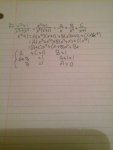
The fist so many pages are illegible, so I made this to detail the work I've done in attempted to solve #24. (I know, it is quite scattered, and I screwed up some notatoion; I've been working on on Larson's Early Transcendentals, 3.4 since 11 last night).
attachment.php

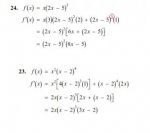
Checking the instructor's manual, I see that I am on the right track, but it just totally buggers my imagination how they reach line 3.
attachment.php

I spent awhile wondering how they got the (2) in the middle of the second line (#24) before I realized that I'd forgotten to add the u' from the General Power Rule. I've poured over the other formulae, but I'm at a loss as to how they jumped to that third line. I have no doubt it is something stupid that I forgot - it usually is - and so it is with some hesitance that I bring myself to beg for assistance. I just need a hint, even a riddle will do, the answer to which will lead me on the right track.
 

Attachments

  • 3.jpg
    3.jpg
    52.2 KB · Views: 9
  • 27.jpg
    27.jpg
    47.1 KB · Views: 1
  • 23 24.jpg
    23 24.jpg
    11.2 KB · Views: 9
attachment.php

Checking the instructor's manual, I see that I am on the right track, but it just totally buggers my imagination how they reach line 3.... I've poured over the other formulae, but I'm at a loss as to how they jumped to that third line.
I think you mean that you're having trouble in going from the first to the second of these two lines:

. . . . .f '(x) = x(3)(2x - 5)2(2) + (2x - 5)3(1)

. . . . .f '(x) = (2x - 5)2 [6x + (2x - 5)]

What did you get when you did the algebra? That is, when you took the common factors (being two of the instances of the 2x - 5)out front, and combined the rest? ;)
 
I think you mean that you're having trouble in going from the first to the second of these two lines:

. . . . .f '(x) = x(3)(2x - 5)2(2) + (2x - 5)3(1)

. . . . .f '(x) = (2x - 5)2 [6x + (2x - 5)]

What did you get when you did the algebra? That is, when you took the common factors (being two of the instances of the 2x - 5)out front, and combined the rest? ;)


I can get to
f '(x) = x(3)(2x - 5)2(2) + (2x - 5)3(1)
no problem, but that is where I get stuck. What operation are you performing to get the [6x+(2x-5)]? What happened to the exponent?
 
I can get to
f '(x) = x(3)(2x - 5)2(2) + (2x - 5)3(1)
no problem, but that is where I get stuck.

Do like I said: Find the common factors. Take them out front. Combine what's left.

What do you get when you do this? Please show your steps. Thank you! ;)
 
I can get to
f '(x) = x(3)(2x - 5)2(2) + (2x - 5)3(1)
no problem, but that is where I get stuck. What operation are you performing to get the [6x+(2x-5)]? What happened to the exponent?

To be just a bit more specific than stapel
x(3)(2x - 5)2(2) + (2x - 5)3(1) = 6 x (2x-5)2 + (2x-5)3 = 6 x (2x-5)2 + (2x-5) (2x-5)2
 
To be just a bit more specific than stapel
x(3)(2x - 5)2(2) + (2x - 5)3(1) = 6 x (2x-5)2 + (2x-5)3 = 6 x (2x-5)2 + (2x-5) (2x-5)2

I think I understand what's going on here. I'm getting close, at least.
The mathematics at the Canadian high school I attended was in a most abysmal state. I am almost entirely self-taught, having taught myself algebra I to get into high school, and Precalculus after high school to make up for the deficits resulting from the most incompetent of teachers (the kind of "teacher" that literally cannot tell a "pi" from a "sigma"). If you could give me a name or a more general descriptor for this procedure you have done, I could check my textbooks and correct yet another deficit before moving on in my study of the Calculus of Fluxions.

In an attempt to understand, I wrote out the following:

xB2 + B3
xB2 + BB2
B2(x + B)

And so I surmise

6 x (2x-5)2 + (2x-5) (2x-5)2
(2x - 5)2
(6x + (2x-5))
(2x - 5)2(8x-5)

It actually just sunk in - what I've done, using my original "B"s as a template. But still, a general name (am I simply making use of the Commutative Property of Multiplication?) would be of immeasurable assistance in cementing my understanding.
 
Ok, so I've solved 24, but 23 is still off.
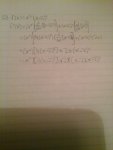
I can find no reason to take the derivative of the first term, (x2), to get (2x), nor do I seem able to find a reason for the 4 (circled in orange) to disappear.
attachment.php
 

Attachments

  • 41BeJGI.jpg
    41BeJGI.jpg
    39.5 KB · Views: 7
... But still, a general name (am I simply making use of the Commutative Property of Multiplication?) would be of immeasurable assistance in cementing my understanding.
Associative, Commutative and Distributive.

Ok, so I've solved 24, but 23 is still off.
I can find no reason to take the derivative of the first term, (x2), to get (2x), nor do I seem able to find a reason for the 4 (circled in orange) to disappear.
...

I'm not sure what you mean but, assuming you understand how to get to your last line,
f'(x) = x2 [4 (x-2)3] + 2x (x-2) (x-2)3
let's continue from there
f'(x) = x2 [4 (x-2)3] + 2x (x-2) (x-2)3
= x2 4 (x-2)3 + 2x (x-2) (x-2)3
= (x-2)3 4 x2+ (x-2)3 2x (x-2)
= (x-2)3 [4 x2+ 2x (x-2)] = (x-2)3 [2x 2x+ 2x (x-2)]
= (x-2)3 2x [2x+ (x-2)]
...

Again you have used the Associative, Commutative and Distributive laws. Maybe this discussion would help
https://www.mathsisfun.com/associative-commutative-distributive.html
 
Top