Anthonyk2013
Junior Member
- Joined
- Sep 15, 2013
- Messages
- 132
This is the question.
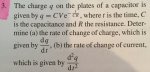
3. The charge q on the plates of a capacitor is given by:
. . . . .\(\displaystyle q\, =\, CVe^{-\frac{t}{CR}}\)
where t is the time, C is the capacitance, and R is the resistance. Determine:
(a) the rate of change of charge, which is given by\(\displaystyle \, \dfrac{dq}{dt},\,\) and
(b) the rate of change of current, which is given by \(\displaystyle \, \dfrac{d^2q}{dt^2}.\)
This is my attempt at solution.
\(\displaystyle q\, =\, CVe^{-\frac{1}{CR}}\)
\(\displaystyle u\, =\, CV\). . . . .\(\displaystyle \dfrac{du}{dv}\, =\, 0\)
\(\displaystyle v\, =\, e^{-\frac{1}{CR}}\). . . . .\(\displaystyle \dfrac{dv}{dR}\, =\, -\dfrac{1}{CR}\, e^{-\frac{1}{CR}}\)
\(\displaystyle \dfrac{du}{dq}\, =\, \bigg(\, CV\, \bigg)\, \bigg(\, -\dfrac{1}{CR}\, e^{-\frac{1}{CR}}\, \bigg)\, +\, \bigg(\, e^{-\frac{1}{CR}}\, \bigg)\, \bigg(\, 0\, \bigg)\)
Wondering if I'm on the right track.
3. The charge q on the plates of a capacitor is given by:
. . . . .\(\displaystyle q\, =\, CVe^{-\frac{t}{CR}}\)
where t is the time, C is the capacitance, and R is the resistance. Determine:
(a) the rate of change of charge, which is given by\(\displaystyle \, \dfrac{dq}{dt},\,\) and
(b) the rate of change of current, which is given by \(\displaystyle \, \dfrac{d^2q}{dt^2}.\)
This is my attempt at solution.
\(\displaystyle q\, =\, CVe^{-\frac{1}{CR}}\)
\(\displaystyle u\, =\, CV\). . . . .\(\displaystyle \dfrac{du}{dv}\, =\, 0\)
\(\displaystyle v\, =\, e^{-\frac{1}{CR}}\). . . . .\(\displaystyle \dfrac{dv}{dR}\, =\, -\dfrac{1}{CR}\, e^{-\frac{1}{CR}}\)
\(\displaystyle \dfrac{du}{dq}\, =\, \bigg(\, CV\, \bigg)\, \bigg(\, -\dfrac{1}{CR}\, e^{-\frac{1}{CR}}\, \bigg)\, +\, \bigg(\, e^{-\frac{1}{CR}}\, \bigg)\, \bigg(\, 0\, \bigg)\)
Wondering if I'm on the right track.
Last edited by a moderator: