One sided limits: why are the signs on "infinty" different?

ShamaoLee

New member
Joined
Oct 6, 2015
Messages
3
attachment.php

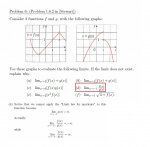
Hello, I would like to ask this limits question, question 6d. The (d) below is the suggested solution.

The solution says that the right and left limits for f(x)/g(x) are negative infinity and infinity respectively. I would like to ask how did they come to this conclusion? If we do one sided limits for f(x) and g(x) separately, they are -1 and 0 and they do exist because the left and right limits are equal. Thus, shouldnt the limit for f(x)/g(x) be -1/0 which is negative infinity? Thank you for your help.:)
 

Attachments

  • Tut2 Q6.jpg
    Tut2 Q6.jpg
    108.3 KB · Views: 14
Last edited by a moderator:
The function f(x) tends toward -1 when x = -1 is approached from either the left or the right. So this part is fine.

The function g(x) tends toward 0 from the negative side of the x-axis when x = -1 is approached from the left, but tends toward zero from the positive side of the x-axis when x = -1 is approached from the right.

So f(x)/g(x) is, roughly speaking, -1/(negative and close to zero) from the left, so the signs are (minus)/(minus) = (plus); but is -1/(positive and close to zero) from the right, so the signs are (minus)/(plus) = (minus).

Hope that helps! ;)
 
The function f(x) tends toward -1 when x = -1 is approached from either the left or the right. So this part is fine.

The function g(x) tends toward 0 from the negative side of the x-axis when x = -1 is approached from the left, but tends toward zero from the positive side of the x-axis when x = -1 is approached from the right.

So f(x)/g(x) is, roughly speaking, -1/(negative and close to zero) from the left, so the signs are (minus)/(minus) = (plus); but is -1/(positive and close to zero) from the right, so the signs are (minus)/(plus) = (minus).

Hope that helps! ;)

Hi, thank you for your reply.

I thought that to find limits for f(x)/g(x) we would take the limit for each function separately at that point and divide them. Does this case apply only when the denominator is zero?(i.e considering the areas to the left and right of the point and dividing them and checking the sign)
 
I thought that to find limits for f(x)/g(x) we would take the limit for each function separately at that point and divide them. Does this case apply only when the denominator is zero?(i.e considering the areas to the left and right of the point and dividing them and checking the sign)
The denominator isn't equal to zero as you approach x = -1; it only equals zero when you are actually at x = -1. Before then, the denominators are very small, but non-zero, values. And those values have signs. ;)
 
The denominator isn't equal to zero as you approach x = -1; it only equals zero when you are actually at x = -1. Before then, the denominators are very small, but non-zero, values. And those values have signs. ;)

I see, thank you very much stapel!:D
 
Top