
Two equalities into one? Tpp = D / [P (r + alpha)]

Felinophile

New member
Joined
Jan 8, 2016
Messages
2
Hello !
I rarely ask for help but I got this assignment last minute while studying for my finals and I would really love some guidance.
I don’t know if it is “possible” so if it is not, please tell me.
I would like to know if it is possible to “merge” those two equalities so that I get f(P) = Y working with both the equalities.

1) Tpp = D/[P (r+α)]

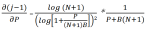
\(\displaystyle \dfrac{\partial\, (j\, -\, 1)}{\partial\, P}\, =\, \dfrac{\log(N\, +\, 1)}{\left(\log\left[1\, +\, \dfrac{P}{(N\, +\, 1)\, B}\right]\right)^2}\, \cdot\, \dfrac{1}{P\, +\, B\, (N\, +\, 1)}\)

2)
I haven’t had a maths class in so long and this just comes out of nowhere so it would be amazing if you gave it a look. Thaank youu in advance ! I don't really know if it's actually feasible but I am hoping it is.
 

Attachments
  • tumblr_inline_o0mo0tfkDV1tf4h9e_540.png
    tumblr_inline_o0mo0tfkDV1tf4h9e_540.png
    8.7 KB · Views: 9
Last edited by a moderator:
Hello !
I rarely ask for help but I got this assignment last minute while studying for my finals and I would really love some guidance.
I don’t know if it is “possible” so if it is not, please tell me.
I would like to know if it is possible to “merge” those two equalities so that I get f(P) = Y working with both the equalities.

1) Tpp = D/[P (r+α)]

\(\displaystyle \dfrac{\partial\, (j\, -\, 1)}{\partial\, P}\, =\, \dfrac{\log(N\, +\, 1)}{\left(\log\left[1\, +\, \dfrac{P}{(N\, +\, 1)\, B}\right]\right)^2}\, \cdot\, \dfrac{1}{P\, +\, B\, (N\, +\, 1)}\)

2)
I haven’t had a maths class in so long and this just comes out of nowhere so it would be amazing if you gave it a look. Thaank youu in advance ! I don't really know if it's actually feasible but I am hoping it is.

What are your thoughts? What have you done so far? Please show us your work even if you feel that it is wrong so we may try to help you. You might also read
http://www.freemathhelp.com/forum/threads/78006-Read-Before-Posting

Which are the constants and which are the variables? [It appears that D, r, \(\displaystyle \alpha\), B, and N are constants, T and j are functions [dependent variables] of the independent variable P], What does

Tpp = D/[P (r+\(\displaystyle \alpha\)]

mean? Possibly

\(\displaystyle \dfrac{\partial^2\, T}{\partial\, P^2}\, = \, \dfrac{D}{P\, (r\,+\,\alpha)}\)?

Were all that the case, I would suggest a re-write: Let

\(\displaystyle y\, =\, j\, -\, 1\)

\(\displaystyle x\, =\, \dfrac{P}{(N\,+\,1)\, B}\)

\(\displaystyle a\, =\, (N\,+\,1)\, \log(N\,+\,1)\)

\(\displaystyle b\, =\, \dfrac{D\, (N\,+\,1)\, B}{r\,+\,\alpha}\)

and write (assuming I didn't make a mistake in defining a and b)

\(\displaystyle \dfrac{\partial^2\, T}{\partial\, x^2}\, =\, \dfrac{b}{x}\)

and

\(\displaystyle \dfrac{\partial\, y}{\partial\, x} \,=\, \dfrac{a}{x\, \log^2(1\,+\,x)}\)

But that then leaves the identity of the other independent variable(s) so I don't think that is quite correct.
 
Last edited by a moderator:
Hello !
Thank you for your answers and I'm sorry I didn't give enough details at first.

It is a financial formula indeed. P being the profit, Tppp being the rate of sharing profits or losses, j being the period, N being the coefficient of proproportionality K = N*B (K is the contribution of the Islamic bank in the Capital), B being the contribution of the entrepreneur to Capital, D being the amount of the loan taken, r the rate of interest and [FONT=MathJax_Math-italic]αD [/FONT]is the fraction of the main debt to repay. When it's a One-Period Model, [FONT=MathJax_Math-italic]α[/FONT] = 1.

I don't know if this is clear enough but those equalities are about financial contracts.

I'm sorry but I don't know how to write the maths formulas correctly. Is there a program I could use ?

For what I've done. Since I couldn't do anything with the derivative, I took this formula and I got P from it.

. . .\(\displaystyle (j\, -\, 1)\, =\, \dfrac{\log(N\, +\, 1)}{\log\left[1\, +\, \dfrac{P}{(N\, +\, 1)\, B}\right]}\)

It gave me : P = B(N+1)[[(j-1)th root of N+1]-1] which I compared with P= (1/Tppp) x D x (r+[FONT=MathJax_Math-italic]α[/FONT]) and I got :

Tppp = 1/(N+1) which I used to get :
P = (B/Tppp)[[(j-1)th root of 1/Tppp]-1]

But I noticed that from the comparing, i'll have B = -D and neither can be negative which is why I assume it is wrong.
I also I'm trying to find a way to go from :

. . .\(\displaystyle (j\, -\, 1)\, =\, \dfrac{\log(N\, +\, 1)}{\log\left[1\, +\, \dfrac{P}{(N\, +\, 1)\, B}\right]}\)

to :

. . .\(\displaystyle \dfrac{\partial (j\, -\, 1)}{\partial P}\, =\, -\dfrac{\log(N\, +\, 1)}{\left(\log\left[1\, +\, \dfrac{P}{(N\, +\, 1)\, B}\right]\right)^2}\, *\, \dfrac{1}{P\, +\, B\, (N\, +\, 1)}\)

When I tried to derivate the first expression, I couldn't manage to get the : 1/(P+B(N+1))

Thanks again !

*
 
Last edited by a moderator:
Top